

Skin First Lip Filler Options: 4–8 Weeks Fuller Lips for Women 40+

For fuller-looking lips without a needle, nothing outlasts the combination of consistent peptide-plus-hyaluronic-acid topical treatment and a long-wear primed color system. Instant plumpers fade within hours; skincare-based routines build modest, cumulative volume over weeks and hold up better long-term. Pair a nightly treatment with the right application technique, and the fullness reads all day, not just for the first ten minutes after you apply it.
TL;DR:
- Peptide and hyaluronic acid treatments gradually increase lip thickness over four to eight weeks, with reversible results if use is discontinued.
- Irritant plumpers provide immediate but very short-term swelling lasting only one to four hours, and frequent use may damage the lip barrier.
- Long-wear primed color systems last six to ten hours but require correct application and priming to prevent early fading or feathering.
- Skincare routines should include gentle exfoliation, consistent nightly peptide-HA use, and careful layering to enhance long-lasting fullness.
- Using products with peptides, hyaluronic acid, humectants, and conditioning ingredients improves results and reduces risk for mature lips, while avoiding irritants like menthol.
Table of Contents
- How do noninvasive lip fillers actually work?
- Which lip filler alternative lasts longer in real use?
- How do you pick the longest-lasting option for mature lips?
- What’s the best routine for longer-lasting fullness?
- How often should you use plumping products, and is it safe long-term?
- How do injectable fillers compare on longevity?
- What affects how long noninvasive results last?
- Are there side effects to worry about with long-wear lip products?
- What do these lip-fullness products typically cost?
- Rebecca’s take: skincare first, color second
- Get the light-reflecting finish that makes any lip routine look fuller
- Sources
How do noninvasive lip fillers actually work?
Every drugstore or luxury alternative to injectable filler falls into one of four buckets, and each works through a completely different mechanism. Confusing them is why so many women feel let down by a $28 plumping gloss that stops “working” the moment it wears off.
- Irritant plumpers use menthol, cinnamon, or capsaicin to trigger mild inflammation and blood flow, creating a temporary swell that dermatologists say lasts about one to four hours.
- Hydration and microsphere formulas rely on humectants that pull water into the lip’s surface layer, softening texture and smoothing fine lines rather than adding real volume.
- Peptide-plus-hyaluronic-acid regimens use ingredients like Palmitoyl Tripeptide-38, which supports the skin’s own production of collagen and hyaluronic acid, building measurable thickness gradually with nightly use.
- Long-wear primed color systems don’t plump anything. They just refuse to budge, keeping pigment locked in place for hours so the shape you drew stays crisp.
A skincare-focused brand leans on the last two categories, formulating skincare-infused color that supports the lip barrier while it wears. That’s a different job than a tingling gloss, and it’s why the results look different too.
Which lip filler alternative lasts longer in real use?
Duration ranges are wildly different across these four categories, and that’s the whole reason “longest lasting” is a trick question without context. An irritant plumper wins on speed. A peptide regimen wins on anything measured in weeks.
- Irritant plumpers: roughly 1 to 4 hours per application, reversible, with dermatologist warnings against frequent use because of barrier sensitivity.
- Hydration/microsphere gloss: a few hours of visible smoothing, longer with reapplication, but no cumulative change.
- Peptide + hyaluronic-acid treatments: modest, measurable gains that build over roughly four to eight weeks of nightly use and reverse if you stop.
- Long-wear primed color: six to ten hours of intact pigment when paired with liner and primer technique.
A small clinical trial testing a topical peptide-hyaluronic regimen in 32 women over four weeks found statistically significant increases in measured lip thickness alongside improved moisturization, according to DermApproved’s review of lip plumper alternatives.
That’s a small sample and a short window, but it’s a real, cumulative effect. Compare that to an irritant plumper, which produces swelling that fully resolves within hours and gives you nothing to show for it the next morning. Injectable fillers exist in an entirely different category, administered by medical providers and measured in months rather than hours or weeks. This article isn’t about that route. It’s about what you can do with a routine and a makeup bag, and on that front, peptide-HA systems are the closest thing to a lasting result that doesn’t require a clinic visit.
How do you pick the longest-lasting option for mature lips?
Not every “plumping” label on a shelf means the same thing, and the wrong pick either does nothing or dries out lips that are already thinner and more prone to vertical lines after 40. Use this checklist before you buy.
- Scan for peptides and hyaluronic acid first. Look for named actives like Palmitoyl Tripeptide-38 or hyaluronic acid microspheres rather than a vague “plumping complex.”
- Add humectants and occlusives. Glycerin, squalane, and shea butter hold moisture in place, which matters more for mature lips because the skin barrier there thins with age.
- Skip anything that leads with menthol or capsaicin as the star ingredient unless you want an occasional, short-lived swell for a single event.
- Choose a satin, creamy, or gloss finish over a flat matte. Makeup artists steer women toward light-reflecting textures because they blur fine lines instead of settling into them.
- Look for primer-hybrid formulas that combine long-wear pigment with conditioning actives like ceramides, so color longevity doesn’t come at the cost of dry, cracked lips.
- Trust specific claims over vague ones. “Clinically tested over four weeks” means something. “Instant dramatic volume” usually does not.
Our guide to lip-plumping ingredients breaks down exactly which actives to look for on a label and which are filler in the other sense of the word.
Pro Tip: Read the ingredient list top to bottom before the marketing copy on the front of the box. Most “24 hour wear” claims are tested under lab conditions without eating, drinking, or talking. Expect real-world wear to run shorter, and plan touch-ups accordingly.
What’s the best routine for longer-lasting fullness?
The order you apply things matters almost as much as what you apply. Skipping straight to lipstick on unprepped lips is the single biggest reason color fades unevenly and looks thinner by lunchtime.
- Exfoliate gently, one to two times a week, never daily. Removing flaky texture helps light reflect evenly across the lip surface, which is a big part of what makes lips look plumper in photos.
- Apply your peptide-HA treatment at night, consistently, for at least six to eight weeks before judging results.
- Prime before color. A thin layer of translucent powder pressed around the lip line after concealer keeps stain from bleeding into fine lines.
- Line just outside your natural border, then fill in with a long-wear stain for the base color.
- Concentrate gloss or a lip hi-lighter only in the center of the bottom lip. That single point of shine tricks the eye into reading more volume across the whole mouth.
- Blot, don’t wipe, if you need a midday touch-up. Wiping strips both color and moisture.
For a deeper walk-through of layering technique, a detailed lip makeup guide for mature women covers finish selection in more detail.
How often should you use plumping products, and is it safe long-term?
Consistency beats intensity here. A nightly peptide-HA treatment works because it’s cumulative, not because any single application does much on its own.
- Peptide-HA treatment: nightly, ongoing. Gains are reversible if you stop, so think of this as maintenance, not a one-time fix.
- Long-wear stain: reapply every 6 to 10 hours or after meals, following the primer routine each time for best hold.
- Irritant plumpers: save them for occasional events only. Frequent use risks compromising the lip barrier and increasing sensitivity.
- Exfoliation: cap it at one to two times weekly. Overdoing it strips the same barrier your hydration routine is trying to build.
Watch for tightness, flaking, or stinging after color application. Those are signs to pause actives for a few days and lean on a plain overnight balm with SPF during the day, especially as seasonal dryness sets in.
How do injectable fillers compare on longevity?
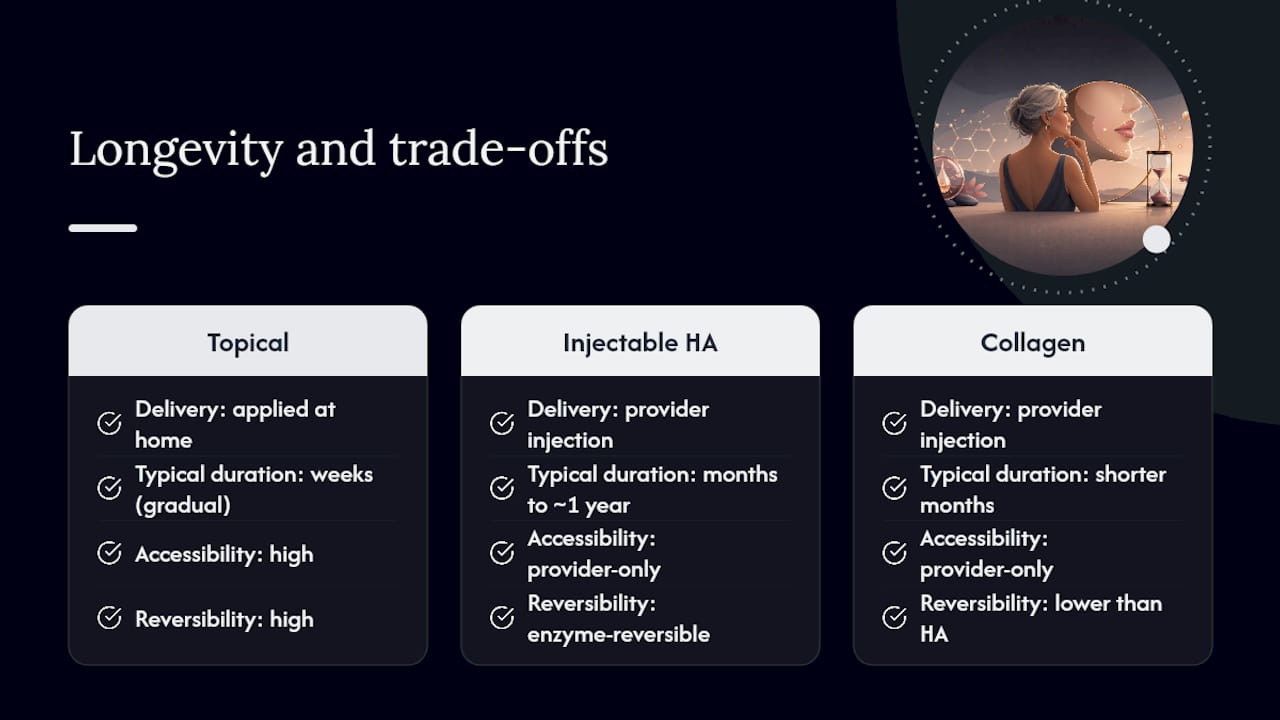
Injectable dermal fillers sit in a different category entirely, administered by medical or aesthetic providers rather than applied at home, but the longevity differences between filler types explain why “how long does it last” has no single answer even in that world. Hyaluronic acid fillers, the most common type, are generally reported to last several months to about a year depending on the specific formulation and how the body metabolizes it. Collagen-based fillers, once more widely used, tend to break down faster because collagen is metabolized more quickly than cross-linked hyaluronic acid. Synthetic or semi-permanent fillers are designed to resist breakdown longer, which is exactly why they carry more scrutiny around reversibility and long-term safety.
The point of raising this isn’t to sell you on injections. It’s context. If you’re comparing a topical peptide-HA regimen to an injectable, you’re comparing weeks of gradual improvement to months of set volume administered by a provider, and expecting a $30 tube to perform like a syringe is where most disappointment starts. The topical route wins on accessibility, reversibility, and zero downtime. It was never going to compete on raw duration against something delivered under the skin.
What affects how long noninvasive results last?
Individual factors change how long any lip-fullness routine appears to work, which is why your results might not match your friend’s even using the identical product. Metabolism plays a role: people who process topical actives faster tend to see peptide-HA gains fade sooner without maintenance. Lifestyle matters just as much. Frequent lip licking, heavy smoking, hot beverages, and sun exposure all speed up moisture loss and undercut whatever a treatment is trying to build.
Application technique is the factor most within your control. Layering order, how much product you use, and whether you prime before color all affect how long a long-wear stain holds its shape. Skip the priming step and even a premium formula will feather into fine lines within a couple of hours. Climate matters too. Dry indoor heat in winter accelerates flaking, which undoes the smoothing benefit that makes lips look fuller in the first place. None of these factors are things a product label can fix for you. They’re routine issues, which is exactly why the step-by-step layering approach matters more than the specific brand you buy.
Are there side effects to worry about with long-wear lip products?
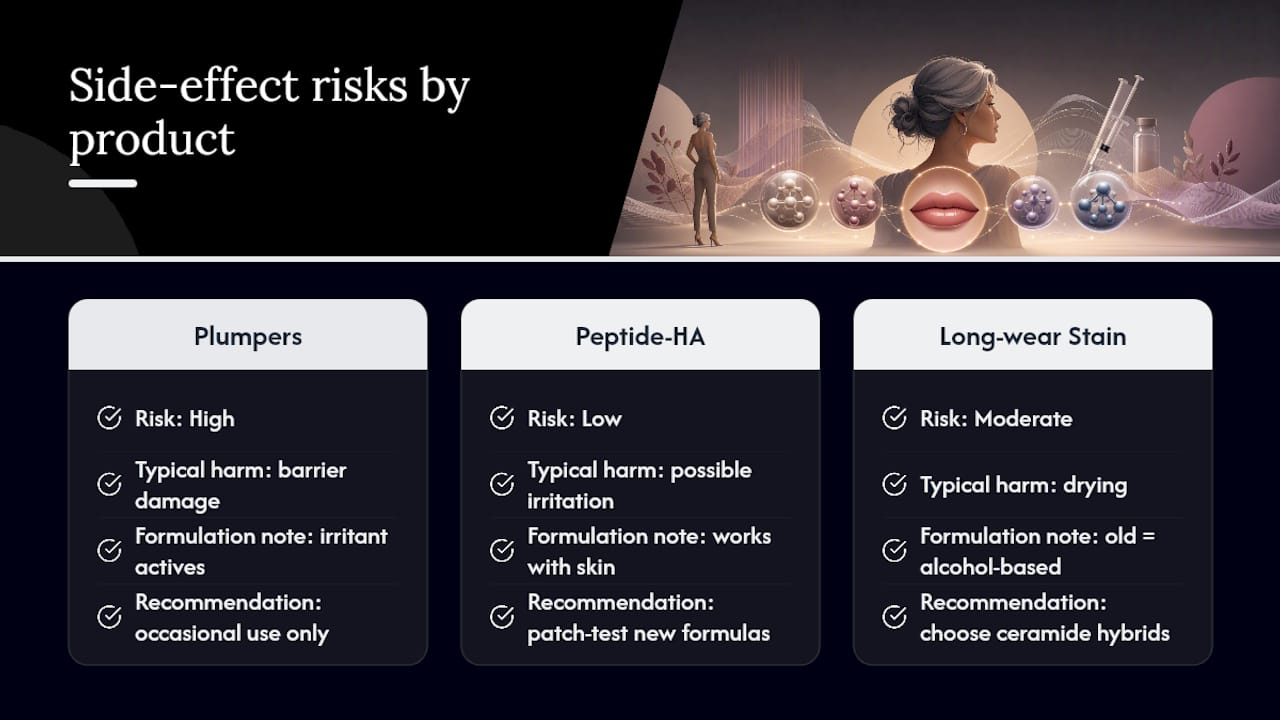
The safety profile differs sharply by category, and lumping them together is where a lot of confusion comes from. Irritant plumpers carry the most direct risk: chronic use can compromise the lip barrier and increase sensitivity, showing up as chapping, stinging, or a rash-like reaction around the mouth. Dermatologists generally recommend reserving them for occasional use rather than a daily habit.
Peptide-HA treatments carry a much gentler risk profile since they work with the skin’s own processes rather than against them, though any new active can cause irritation in sensitive individuals, so patch-testing a new formula for a few days is worth the extra step. Long-wear stains present their own, different issue: some older formulations were notoriously drying because they relied on alcohol-based solvents to grip pigment. Newer primer-hybrid formulas built with ceramides and conditioning actives largely solve that problem, which is one more reason ingredient labels matter more than marketing claims. If you’re using a peptide treatment nightly alongside a long-wear stain during the day, watch for cumulative dryness. Two actives stacked on already-thin mature lips can add up faster than either would alone.
What do these lip-fullness products typically cost?
Price ranges vary enormously across categories, and higher cost doesn’t reliably mean longer-lasting results. Irritant plumpers sit at the low end, often in the $10 to $25 range for a single gloss or balm, reflecting how little formulation complexity they require. Hydration and microsphere-based plumping glosses run a bit higher, typically $15 to $35, since they usually include more humectants and conditioning oils.
Peptide-plus-hyaluronic-acid treatments cost more because the actives themselves are expensive to formulate and test. Expect $30 to $60 for a nightly treatment, and remember this is an ongoing cost, not a one-time purchase, since results depend on continued use. Long-wear primed color systems, including liner and stain sets, land anywhere from $20 to $50 per piece, with curated kits that bundle liner, stain, and a finishing gloss often priced as a set rather than piece by piece. The real cost comparison isn’t the price tag on one tube. It’s what you’re paying monthly to maintain a routine, since a peptide treatment used nightly for eight weeks costs more cumulatively than most people expect walking into the purchase.
Rebecca’s take: skincare first, color second
If I had to bet on one habit that actually moves the needle, it’s the boring one: a nightly peptide-HA treatment used for two full months before judging it, paired with long-wear color reserved for days you actually need staying power. Most women give up on topical treatments around week two, right before the cumulative effect the small clinical trials describe would have started showing.
The instant-gratification plumpers aren’t wrong to use occasionally. They’re wrong to rely on as a strategy. Real, lasting fullness for mature lips comes from patience and layering technique, not from whichever gloss tingles the most in the store.
— Rebecca
Get the light-reflecting finish that makes any lip routine look fuller
Once your peptide-HA treatment and long-wear color are doing their job, the last piece is optical: a strategically placed highlight that makes the center of your lip catch light the way naturally fuller lips do. Luméra Cosmetica’s Ombre Effect Lip Hi-Lighter is built for exactly that step, formulated with skincare-infused ingredients so it adds shine without undoing the hydration work your nightly routine already did.
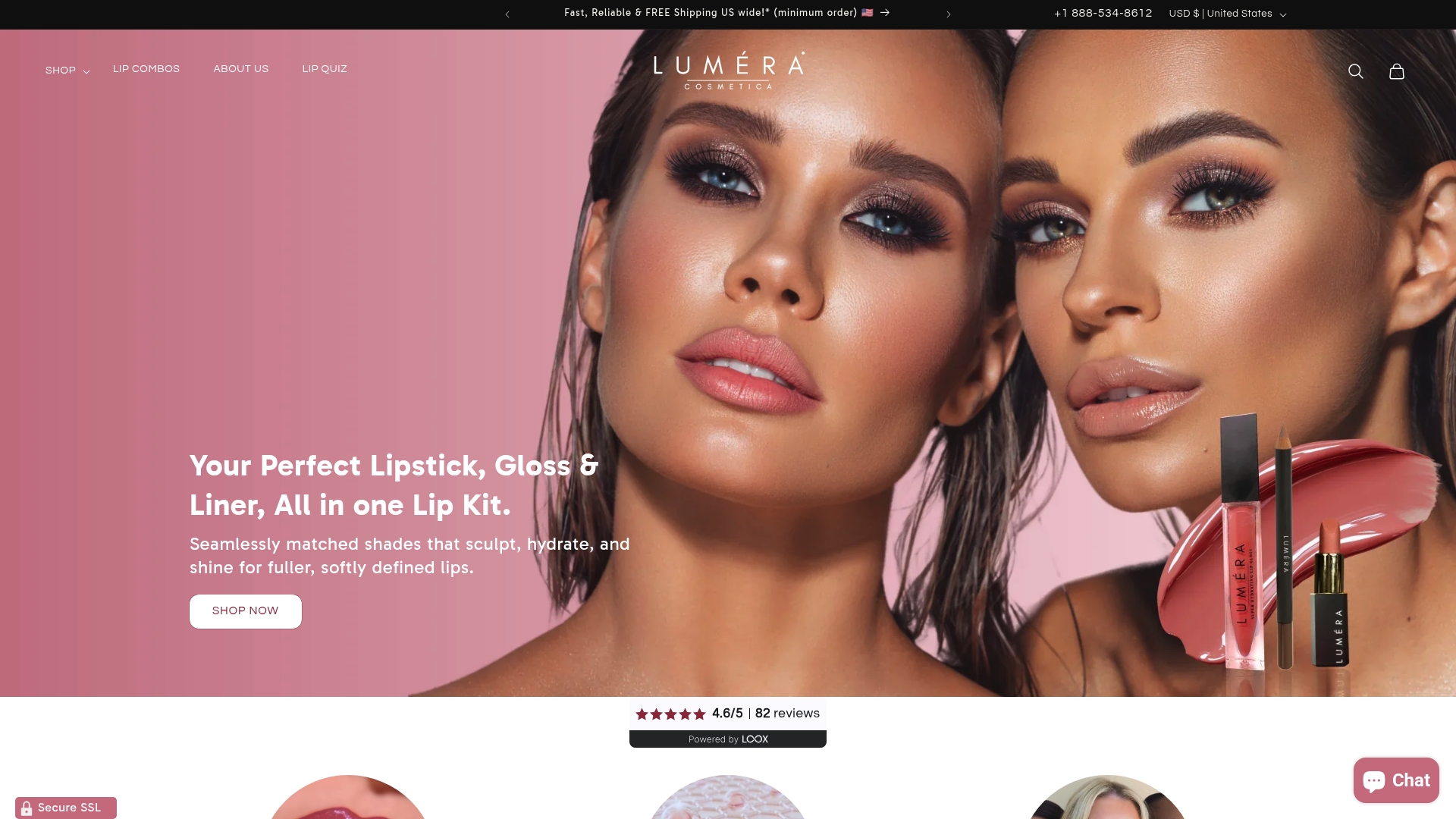
Use it as the final layer over your liner and long-wear stain, dabbed onto the center of the bottom lip where light naturally hits first. It’s especially useful before photos or events, when you want the fullness from your routine to actually show up on camera, not just in the mirror. Pair it with the creamy lip gloss formulas built for mature lips if you want a softer, all-day option instead of a targeted highlight. Either way, shop the Ombre Effect Lip Hi-Lighter and add it to a routine that’s already doing the hard work.
Sources
- Efficacy and tolerability of a topical peptide-hyaluronic treatment (journal article)
- Lip plumpers & filler alternatives — DermApproved
- Allure
- 5 Best Lipsticks for Older Women — Glamour


