

Match Your Natural Lip Color: Six Research Backed Families for 40+

Most natural lips fall into six families: peach, soft pink, rose, mauve, berry, and brown/nude, each shifting with how much melanin and blood vessel color show through the vermilion. The matching rule that actually works is simple: match lightness first, then fine-tune warm or cool undertone. Lips also darken and turn slightly more yellow with age, so a shade that worked at 30 often needs adjusting at 50.
TL;DR:
- Lips generally become darker and more yellow with age, requiring adjustments in shade and formulation to maintain natural-looking results.
- Natural lip color varies widely across individuals and cannot be accurately predicted by skin tone or ethnicity alone, emphasizing the importance of personal testing.
- Matching lip shade should start with assessing lightness in daylight and then fine-tuning warm or cool undertones based on the natural lip family.
- Sheer or layered gloss and hydrating formulas are preferable for mature lips to enhance natural texture and prevent dryness or fine lines.
- “Nude” lip shades span a broad spectrum, so selecting one should involve personal experimentation rather than relying on a single universal color.
Table of Contents
- Common Natural Lip Color Families and How to Recognize Each
- What the Research Says About Lip Color Diversity
- How to Identify Your Natural Lip Color at Home
- Choosing the Right Natural Shade and Formula
- What Changes About Lip Color After 40
- Nude Is Personal, Not a Rulebook
- Find Your Shade With Lumeracosmetica
- Sources
- FAQ
Common Natural Lip Color Families and How to Recognize Each
Peach reads light, warm, and low in saturation. It’s the shade you see on fair to light skin where blood vessels sit close to the surface but melanin is minimal. Soft pink sits one step darker and slightly cooler, common on light to medium skin tones with a neutral undertone.
Rose adds more red pigment without heavy warmth, showing up across a wide range of skin tones because it splits the difference between pink and berry. Mauve leans cool and dusty, a muted purple-brown that tends to appear on medium to olive skin. Berry deepens the saturation into wine or plum territory, often on medium to deep skin tones where more melanin mixes with visible blood vessel color. Brown/nude covers the warmest, most melanin-influenced end of the spectrum, typically on deep skin tones.
Here’s the pattern worth remembering:
- Peach and soft pink cluster at the lighter end, where blood vessels dominate the color you see.
- Mauve and berry sit in the middle, blending red undertones with more melanin.
- Brown/nude sits at the deepest end, where melanin does most of the work.
- Lighting changes everything: a rose lip can photograph pink under phone flash and mauve under warm indoor bulbs.
Check your natural lip color in daylight near a window, then again under a bathroom bulb. If the family looks different in each light, trust the daylight reading. It’s closer to how people actually see you outdoors and in most social settings.
What the Research Says About Lip Color Diversity
“Nude” isn’t one shade. It’s a spectrum wide enough that a single generic lipstick sold as “nude” will look wrong on most of the people who buy it.
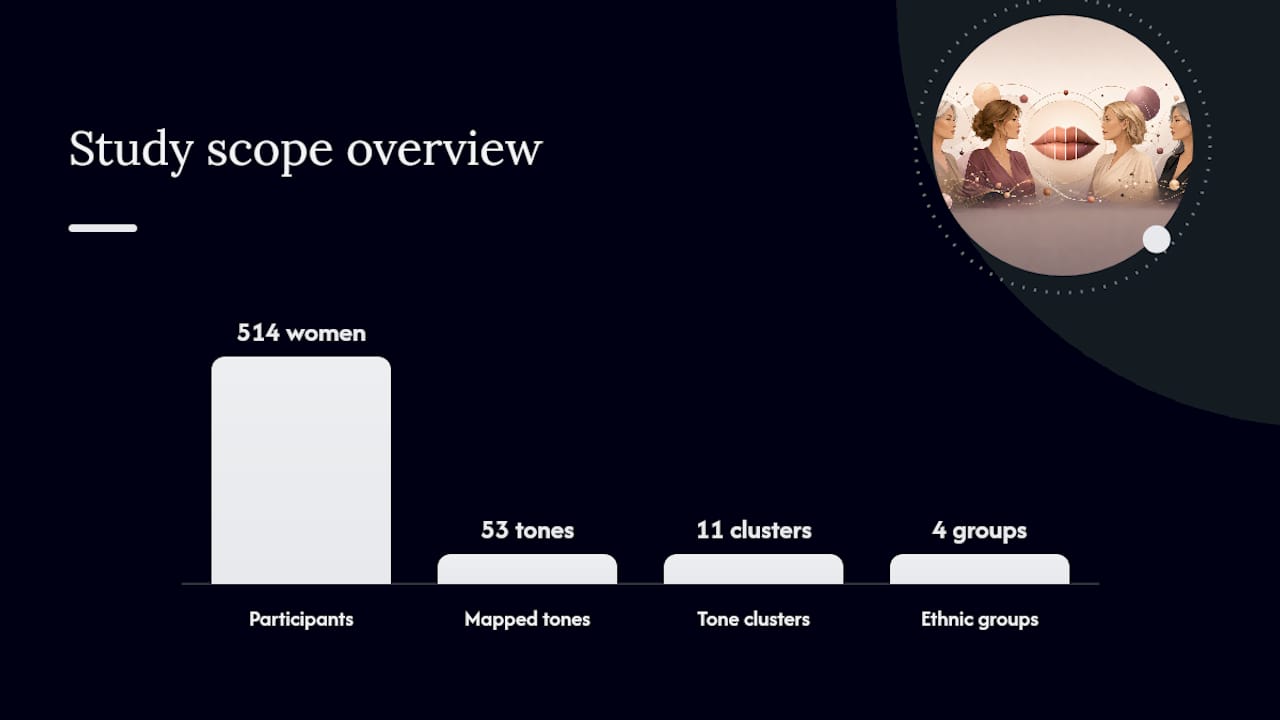
A 2025 hyperspectral imaging study of 514 women across four ethnic groups mapped natural lower-lip color into a 53-tone reference chart, and Hispanic women showed the widest range of natural lip shades among the groups measured. That’s a lot more variation than the beauty aisle usually accounts for.
By the numbers: Colorimetric analysis of lip tones sorted them into 11 broader clusters based on lightness, redness, and yellow undertone, revealing patterns that hold across skin types.
Two patterns showed up consistently in that clustering work:
- Darker lips measured less saturated and more yellow in undertone.
- Lighter lips measured redder and more saturated.
The same research found heavy overlap within and across ethnic groups, meaning lip tone can’t be predicted from skin tone or ethnicity alone. Two women with nearly identical skin can have noticeably different natural lip colors. The practical takeaway: test your own lips rather than assuming a shade based on your skin tone or background. That’s also why researchers behind the lip colour chart study argue for multiple mapped nude shades instead of one catch-all.
How to Identify Your Natural Lip Color at Home
You don’t need a colorimeter to figure out where you land. A few low-tech tests get you most of the way there.
- Take a bare-face photo in natural light. Stand near a window at midday, no filter, no flash. Overhead indoor lighting distorts warm and cool tones more than people realize.
- Compare your lip color against your jawline. Hold a plain tissue against your jaw and your lips side by side in that same natural light. This tells you whether your lips run lighter or darker than your surrounding skin, which is the real starting point for lightness matching.
- Check the inner versus outer lip. The inner vermilion (closer to your teeth) usually shows your truest pigment, since it hasn’t been affected by sun exposure or years of product use the way the outer lip has.
- Do a blot test. Press a clean tissue to your lips after cleansing. The faint color left behind often reveals underlying pigment that gets masked by dryness or flaking on the surface.
- Watch for pitfalls. Recent coffee, red wine, or a tinted balm can leave a temporary stain that skews your reading. Wait at least twenty minutes after eating or drinking before testing.
Pro Tip: Photograph your jawline comparison test and save it in your phone. Pull it up in the store or while shopping online so you’re matching against your actual lip tone, not your memory of it.
Once you’ve got a lightness reading and a rough family, the three-test shade guide walks through swatch comparisons that narrow things further.
Choosing the Right Natural Shade and Formula
Match lightness before anything else. A rose that’s two shades too dark will always look heavier than a rose that’s a half shade off in undertone. Once lightness lines up, adjust for warm or cool.
Two examples make this concrete:
- Someone with naturally light, peachy lips who wants definition without change should pick a soft pink one shade darker than their bare lip, not a brown nude that fights their undertone.
- Someone with naturally deep, brown-toned lips who wants a “no-makeup” look should reach for a warm berry or chocolate nude, since a pale pink will read ashy against that base pigment.
Format matters as much as shade. A sheer tint merges with existing lip pigment and enhances what’s already there. An opaque lipstick changes the color outright, useful if you want more contrast than your natural tone gives you. A gloss sits somewhere between the two, adding shine without much pigment shift.
For mature lips, formulation deserves as much attention as shade:
- Prioritize hydration first. Thinner, drier lips show every flake in a matte finish.
- Skip heavy matte formulas that flatten texture and settle into fine lines.
- Use a liner slightly darker than your natural lip to restore definition that softens with age.
- Layer a sheer tint over the liner instead of one thick coat of opaque color for a more natural build.
Pro Tip: Blot after the first layer of color, then add a second thin layer. It looks more lived-in and lasts longer than one heavy application.
The nude lipstick application guide covers the liner-and-layer technique step by step if you want a visual walkthrough.
What Changes About Lip Color After 40
Lips darken and pick up more yellow undertone with age, a shift documented alongside the broader colorimetric clustering research on lip tone. Lips also thin and lose some of their natural definition, which means the shade that flattered you at 30 can look muddier or flatter now.
The fix isn’t a dramatically different color family. It’s adjusting formulation: more hydration, a liner to rebuild the lip line, and a satin or sheer finish instead of full matte. Rebecca, who focuses on mature-lip looks, builds shade guidance around this exact adjustment rather than chasing trend colors that ignore how lips actually age.
Nude Is Personal, Not a Rulebook
Here’s what gets missed in most shade guides: “nude” was never meant to describe one color. It’s shorthand for “close to your own pigment,” and your own pigment is unlike anyone else’s. Treating it as a single universal shade is why so many nude lipsticks disappoint people the moment they try them on.
I’d rather see people run small experiments than follow a rigid chart. Buy one tint a shade lighter and one a shade darker than your test result, wear each for a day, and see which one actually looks like you by midafternoon, not just under store lighting. Inclusive shade ranges matter because lip color is genuinely that varied, and the only real test is your own face in your own light.
— Rebecca
Find Your Shade With Lumeracosmetica
Once you know your lightness and undertone, the fastest way to act on it is a kit built around that logic instead of a single guess-and-check lipstick. Some lip kits are curated to pair a liner, lipstick, and gloss so the tone-on-tone approach from this article is already built in rather than something you have to assemble yourself.
Formulas with skincare-infused ingredients can matter more after 40 when hydration and texture affect how any color sits on the lip. If you’re not sure where your rose ends and your mauve begins, start with the brand’s guide to what nude lipstick actually means and its mature-lip shade guidance, then browse the curated kits built around those same lightness-and-undertone rules to find your match.
Sources
- Development of a lip colour chart across four ethnicities
- Lip color diversity: an intricate study (PMC)
- Lip color and health | Abreva
FAQ
What are the main types of natural lip color?
The main families are peach, soft pink, rose, mauve, berry, and brown/nude, distinguished by lightness, warmth, and how much melanin shows through the lip.
How do I know my natural lip undertone?
Compare your lips to your jawline in natural daylight, and check the inner vermilion near your teeth, since it usually shows your truest pigment without sun or product buildup.
Is there one universal “nude” lip color?
No. Research mapping 53 distinct lip tones across ethnic groups confirms nude is a wide spectrum, not a single shade, so matching depends on your own lightness and undertone.
Does natural lip color change with age?
Yes, lips tend to darken and take on more yellow undertone over time, which is why formulation and liner technique often matter more than shade choice after 40.
When should a lip color change concern me?
Reddish pink to brown is the normal healthy range; blue, pale, or gray lips can signal a circulation or oxygenation issue and warrant medical attention.


