

Find Your Makeup Shade in 3 Tests for Women 40+, Mix and Shop Smart

Your “makeup shade” question, in this context, is about your lip color, not your foundation: it means finding the lipstick, liner, or gloss shade that harmonizes with your undertone and skin depth. The fastest path there is to identify whether you lean warm, cool, or neutral, then pick a mid-tone shade in that family. From there, a few quick tests and some smart shopping habits will get you the rest of the way.
TL;DR:
- Choosing the right lip shade depends primarily on correctly identifying your undertone through simple tests like vein color, jewelry fit, and natural lip flush in daylight.
- The same color can look vastly different depending on undertone, with warm shades like brick and peach for warm undertones, and berry or blue-reds for cool undertones.
- Mid-tone shades with some shine and hydrating finishes tend to flatter mature lips better by creating the illusion of fullness and preventing dryness.
- Testing lip color directly on your lips under natural light gives a more accurate idea than swatches on your hand, especially for serious color matches.
- Lighting conditions dramatically shift how lipstick appears, so it’s essential to view shades in natural daylight before making a purchase, especially online.
Table of Contents
- How Do I Find My Lip Shade at Home?
- Why Undertone Changes How Lip Color Looks on You
- Which Lip Shades and Finishes Flatter Mature Lips?
- How to Mix or Layer Lip Products for a Custom Shade
- What Should I Check Before Buying Lipstick Online?
- How Does Lighting Change the Way Lip Color Looks?
- Should I Test Shades on My Lips or My Skin?
- Do Lip Shades Need to Change With the Seasons?
- Is My Lip Undertone the Same as My Skin Undertone?
- Rebecca’s Three Rules for Shade Matching Mature Lips
- Ready to Shop Your Shade? Start Here
- Sources
- FAQ
How Do I Find My Lip Shade at Home?
You don’t need a color consultant for this. Three low-tech tests, done back to back, will tell you almost everything you need to know before you shop.
- Check your wrist veins. Blue or purple veins usually point to a cool undertone. Green veins suggest warm. Can’t decide, or see a mix of both? You’re probably neutral.
- Try the jewelry and white paper tests. Gold jewelry flattering your skin signals warm undertones; silver flattering you more points to cool. Hold a plain white sheet of paper next to your face: skin that looks yellowish or golden against it leans warm, while skin that looks pink or bluish leans cool. These two tests, outlined by Lipstick Queen, are the standard starting point makeup artists rely on.
- Bite your lip, gently. The natural flush that rises to the surface is your MLBB, or “my lips but better” shade. Makeup artist Bobbi Brown built her entire shade-matching approach around this trick, using that bitten-lip color as the anchor for everything else you try on.
Once you know your undertone, you have a starting shade family: warm undertones lean toward brick reds, terracotta, and peachy browns; cool undertones lean toward berry, blue red, and rosy mauves; neutral undertones can wear almost anything but often look best in rosewood or mid-tone pinks.
Pro Tip: Do all three tests in daylight near a window. Indoor bulbs, especially warm-toned LED bulbs, can throw off your undertone reading before you even pick up a lipstick.
Why Undertone Changes How Lip Color Looks on You
Undertone is the underlying warmth or coolness in your skin. It doesn’t change with a tan or a season, unlike surface tone, which is just how light or dark your skin looks right now. This distinction matters more for lips than almost any other part of your face, because lip pigments interact directly with your skin’s warmth or coolness the moment they touch your lips.
Color theory for lipstick centers on matching pigment to undertone rather than to a shade name on a label. “Coral” from one brand can lean orange, while “coral” from another leans pink, and only your undertone tells you which one will work.
Here’s how the same color family splits by undertone:
- Warm undertones: orange reds, brick, rust, and peachy browns look rich rather than muddy.
- Cool undertones: blue reds, berry, and rosy mauve read as vibrant rather than harsh.
- Neutral undertones: true reds and rosewood tend to sit well without a strong pull either way.
A blue red and an orange red can look almost identical in a tube, but on skin they behave completely differently. Blue red brightens teeth and cools down redness; orange red warms things up but can look muddy on a cool undertone. That’s the whole game.
Which Lip Shades and Finishes Flatter Mature Lips?
Lip volume naturally softens with age, and shade intensity plays a bigger role in how full your lips look than most women realize. Makeup artists point out that brighter, mid-tone shades and shades with some shine reflect light and create the illusion of fullness, while very dark or heavily matte shades can flatten that same lip and make it look thinner.
Shades worth building a collection around:
- Mid-tone rosewoods and dusty roses
- Soft berries, rather than deep wine or plum
- Peachy browns and brick reds
- Pink-peach nudes, which pros frequently name as the single most flattering shade for a youthful look
Shades to approach with caution: near-black plums, extremely pale “greige” nudes, and anything with a heavy ash or gray undertone, since all three tend to wash out mature lips or emphasize dryness.
Finish matters just as much as color. A satin or gloss finish catches light and adds the appearance of volume; an ultra-matte finish sits flat and can sink into fine lines. Formulas built with hydrating ingredients like squalane, jojoba, or meadowfoam seed oil hold up better through the day and resist settling into lip lines, something plain matte bullets struggle with on mature lips.
How to Mix or Layer Lip Products for a Custom Shade
You don’t have to find one perfect tube. Layering and mixing two or three products is a legitimate professional technique, and it’s honestly the fastest way to fix a shade that’s “almost right.”
- Line first, with a shade slightly deeper than your natural lip color. This anchors the color and keeps it from bleeding.
- Fill in with a creamy bullet in your target shade. Cream formulas blend into liner more evenly than matte ones.
- Add gloss over the top, or just at the center of the lip, to boost shine and perceived fullness.
- To warm a shade, dab on a small amount of an orange or peach gloss. To cool it down, layer a berry or rose gloss instead.
- To soften intensity, blot after applying, then add a sheer balm. This dilutes pigment without changing the undertone.
Makeup artists describe this pigment-mixing approach as transferable across brands, which means you can combine products from completely different lines once you understand how their pigments behave. When you’re shopping online, product descriptions that mention “blue red,” “warm brick,” or “cool berry” are telling you exactly how a shade will act once mixed. Lumeracosmetica’s own guide to mixing lip colors walks through more combinations if you want a custom result from products you already own.
What Should I Check Before Buying Lipstick Online?
Returns are annoying, and lip products are one of the harder categories to buy blind. A short checklist before you click “add to cart” saves you both money and disappointment.
- Read the product description for undertone language: warm, cool, or neutral, plus pigment cues like “brick,” “berry,” or “rose.”
- Check whether the brand shows swatches on multiple skin depths, not just one model.
- Note the finish (satin, gloss, cream, balm) and any hydrating ingredients listed.
- Order one MLBB shade plus one slightly bolder accent shade, or start with a curated kit built for your undertone family.
- Look at buyer photos, if available, on skin tones close to yours, and check what lighting those photos were shot in.
- Confirm the return policy before you buy more than one or two products at once.
How Does Lighting Change the Way Lip Color Looks?
Lighting can shift a lip shade so dramatically that two people can look at the same lipstick and disagree about what color it even is. Warm indoor bulbs push every shade toward orange and gold, which can make a true red look brick and a cool berry look almost brown. Cool white LED lighting, common in bathrooms and office settings, does the opposite: it pulls pink and blue forward, making a warm coral look more mauve than it really is.
Fluorescent lighting, still common in some retail stores, tends to flatten color and wash out subtle shifts between similar shades, which is part of why a lipstick can look perfect under store lighting and slightly off once you step outside. Camera flash adds another layer of distortion, often blowing out shine and making glossy finishes look brighter and more diffused than they appear in person.
Daylight, especially indirect daylight near a window, is the closest thing to a neutral baseline. If you’re trying to judge a shade from a product photo online, look for images shot in or near natural light, and be skeptical of shades shown only under warm studio lighting or heavy flash. When you’re testing a shade at home, check it under at least two light sources: your bathroom mirror and a spot near a window. If the color reads consistently flattering in both, you’ve likely found a true match rather than a lucky lighting moment.
Should I Test Shades on My Lips or My Skin?
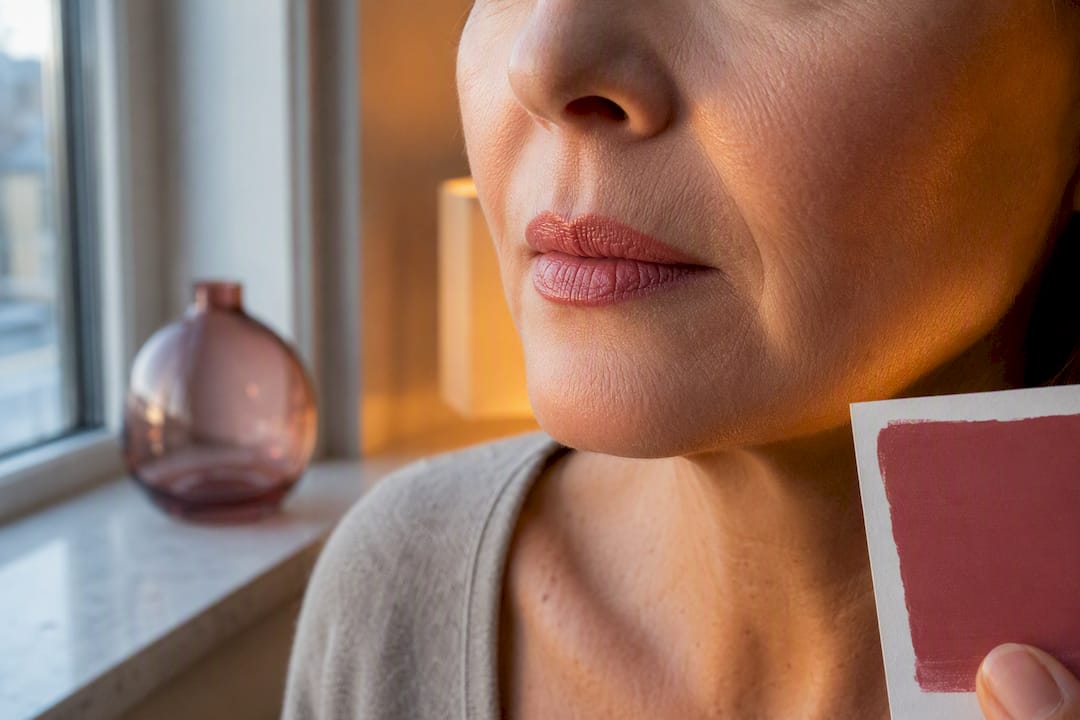
Testing on the back of your hand or your inner wrist is a habit worth breaking. Skin swatches are useful for judging undertone and finish, but they consistently mislead you about how a shade will look on your actual lips.
Lip skin has a different texture and a different baseline color than the skin on your hand or wrist, and it reacts to pigment differently, too. A shade that looks soft and sheer on your wrist can turn out considerably more saturated on your lips, because lip tissue has less surface texture to diffuse the pigment. That’s why the bite test described earlier works better as a guide than any wrist swatch: it’s testing lip pigment behavior on lip skin, not a stand in for it.
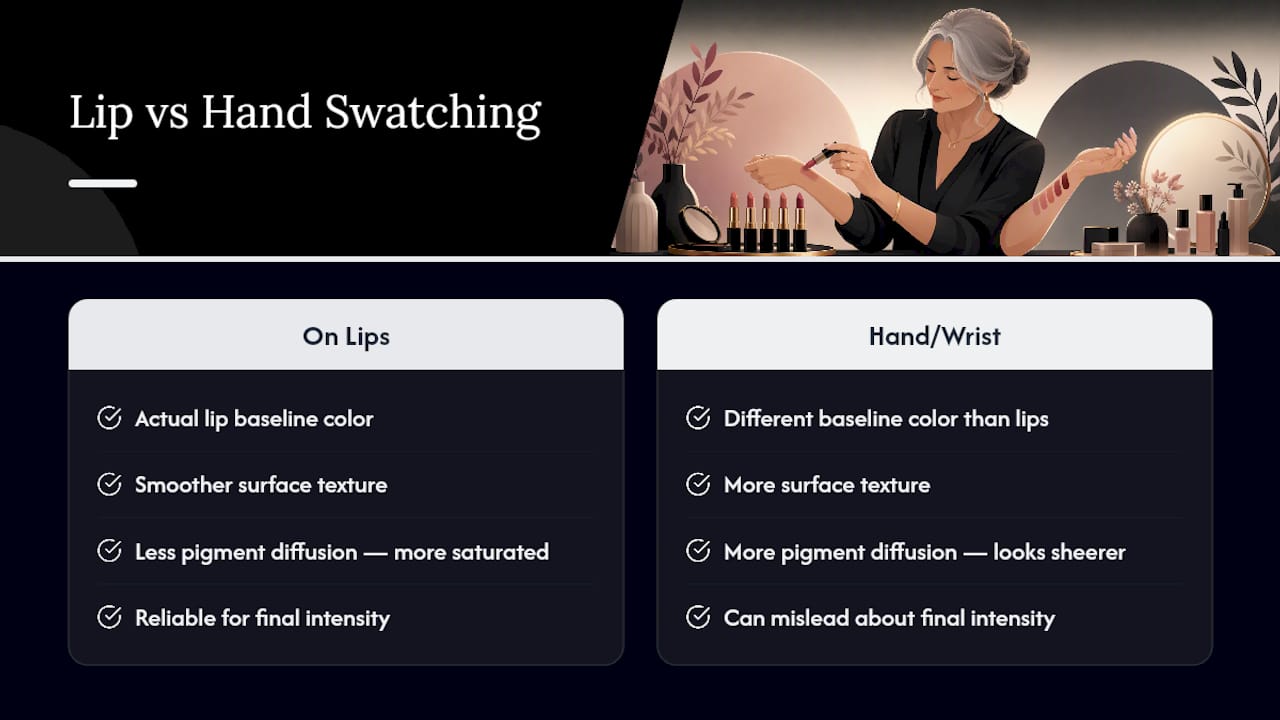
If you’re shopping online and can’t test in person, use skin swatches only to judge two things: general undertone family and finish (does it look matte, glossy, or metallic). Save any judgment about exact intensity for when the product arrives, and test it directly on your lips in daylight before deciding it’s wrong. A shade that reads “too bold” on a hand swatch photo often settles into something much more wearable once it’s actually on lip skin, especially with a mid-tone or sheer formula.
Do Lip Shades Need to Change With the Seasons?
Your undertone stays fixed year round, but the intensity and finish that feel right often shift with the seasons, mostly because your skin’s surface tone and hydration levels change. A tan from summer sun temporarily deepens surface tone, which can make a shade that looked perfect in winter suddenly read a little pale or chalky by August.
In colder months, lips tend to run drier, so richer, more hydrating formulas in slightly deeper mid-tones, think dusty rose or soft brick, tend to perform better and look more intentional against paler winter skin. In warmer months, lighter, glossier textures in peachy or coral leaning shades within your undertone family tend to feel more natural, especially against a deeper summer tan.
None of this means buying a whole new lip wardrobe every three months. It means keeping two or three shades within your undertone family on hand, one slightly deeper and richer, one lighter and glossier, and reaching for whichever one matches your current skin depth and the season’s humidity. Trend shades come and go, but the undertone rule doesn’t move: a coral that trends every spring still needs to sit on the warm or neutral side of your palette to actually flatter you.
Is My Lip Undertone the Same as My Skin Undertone?
Not always, and this trips up more shoppers than any other part of shade matching. Your facial skin can read one undertone while your natural lip color leans a different direction, especially as lips lose some of their natural pigmentation with age.
This is exactly why the bite test matters more than any foundation-style undertone quiz: it isolates your lip’s own coloring rather than relying on a reading from your cheek or jawline. If your face tests warm using the vein or jewelry method, but your bitten lip flushes a cooler pink rather than a warm coral, trust the lip test for lipstick shopping. Foundation and lipstick are solving different problems, and treating them as the same test is one of the most common reasons women end up with a lipstick collection that looks right in the mirror but wrong on camera.
Practically, this means you might genuinely wear a cool berry lipstick with warm-toned foundation, and have it look completely natural, because your lips and your skin aren’t obligated to match undertones just because they’re on the same face.
Rebecca’s Three Rules for Shade Matching Mature Lips
I keep this simple with clients, and I’d rather give you three rules you’ll actually remember than a color wheel you’ll forget. First: undertone before anything else, every time, no exceptions. Second: reach for mid-tones and hydrating finishes over anything ultra-matte or ultra-dark. Third: never trust a shade until you’ve seen it in real daylight, not store lighting. Lumeracosmetica’s mixing guide is there if you need to tweak a shade rather than replace it. And if a “wrong” shade still makes you smile in the mirror, wear it anyway. Rules are a starting point, not a cage.
— Rebecca
Ready to Shop Your Shade? Start Here
Skip the guesswork of matching lip color to a screen photo. Curated lip kits and individual lip shades are available, designed with hydrating formulas suited for mature lips.
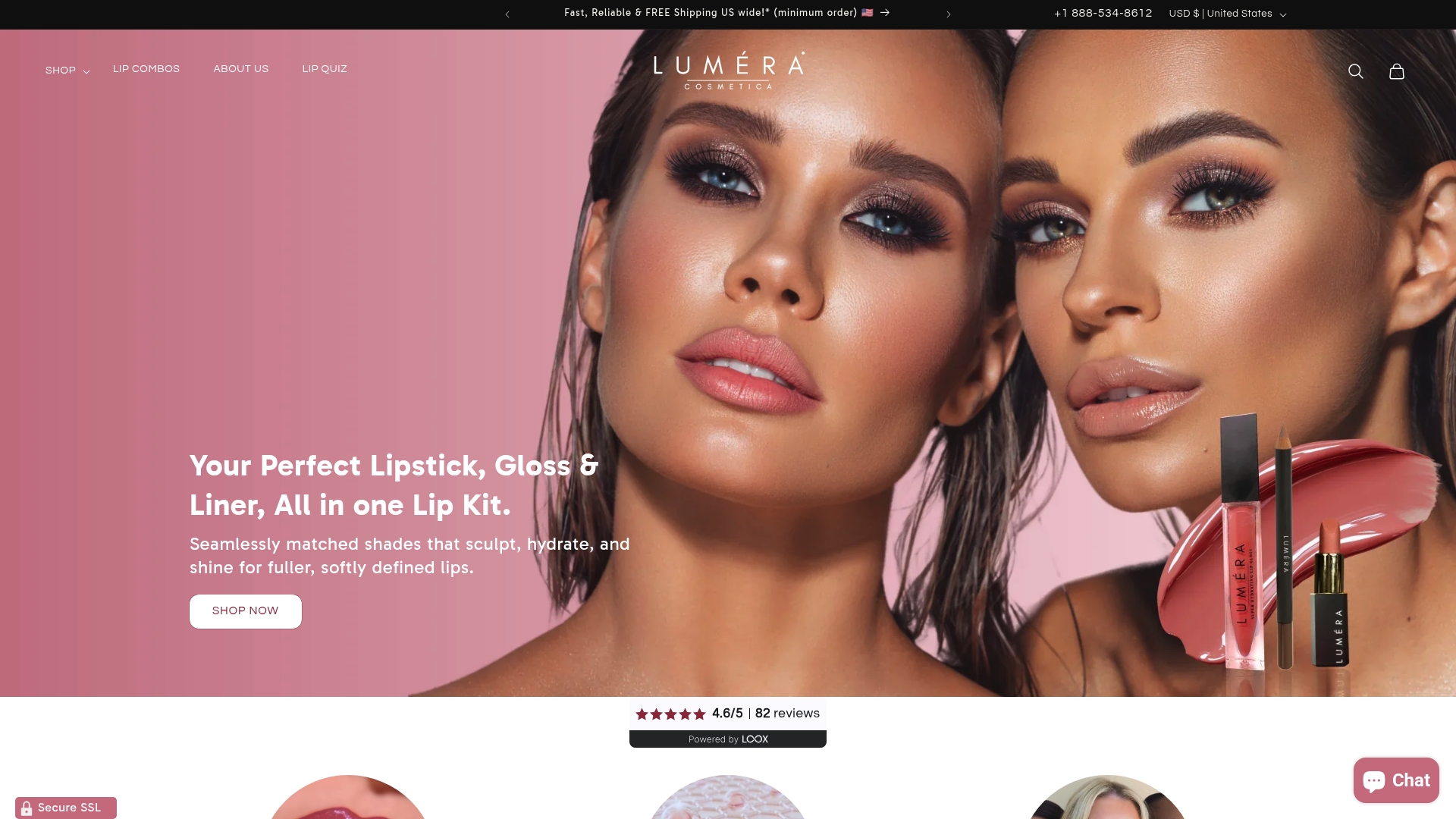
If you tested warm or neutral and want a reliable place to start, the Perfect Kiss Lipstick is built as a wearable mid-tone that works well across most skin depths, with a comfortable, non-drying finish. Order it alongside one bolder accent shade, and if the color needs a small tweak once it arrives, our mixing guide will show you how to warm, cool, or soften it in under a minute.
Sources
This guide draws on undertone testing from Lipstick Queen, color theory from Stylist, and shade guidance from Glamour, Who What Wear, and Prevention.
- 5 Best Lipsticks for Older Women 2026, According to Makeup Artists | Glamour
- Lip colour theory: how to create a bespoke shade for your skin | Stylist
- Bobbi Brown’s simple trick for finding the right shade of lipstick | Prevention
- How to Pick Lipstick Color: A Guide for Every Skin Tone | Lipstick Queen
FAQ
What Does “Makeup Shade” Mean for Lipstick Shopping?
In this context, it refers to the lip product shade, lipstick, liner, or gloss color, that matches your undertone and skin depth, not a foundation shade.
How Do I Know if I’m Warm, Cool, or Neutral?
Check your wrist veins, see which metal jewelry flatters you more, and hold white paper next to your face; green veins and gold jewelry suggest warm, blue veins and silver jewelry suggest cool.
What Is the Best Lip Shade for Women Over 40?
Mid-tone rosewoods, soft berries, brick reds, and pink-peach nudes tend to flatter mature lips best, especially in satin or glossy finishes rather than heavy matte.
Can I Mix Two Lipsticks to Get My Shade?
Yes, mixing a cream lipstick with a gloss in an adjacent shade is a common makeup artist technique for warming, cooling, or softening a color at home.
Does Lighting Really Change How Lipstick Looks?
Yes, warm indoor bulbs push shades toward orange and gold, cool LED lighting pulls them toward pink and blue, and only natural daylight gives you a reliable read on true color.


