Types of Lips: A Beauty Guide for Women Over 40

TL;DR:
- Understanding your lip type and aging morphotype helps you choose the most effective products and treatments.
- Focusing on defining the vermillion border and Cupid’s bow creates more natural, youthful results than adding volume.
Types of lips refer to the distinct natural shapes and volumes that define each person’s lip appearance, and understanding them is the first step to choosing beauty products and treatments that actually work for you. Women over 40 in Australia and Europe face a specific challenge: lip aging morphotypes change the shape and volume you started with, making a one-size approach to lip care ineffective. The vermillion border, the defined ridge outlining the lip’s edge, softens with age. Knowing your lip type and how it has shifted lets you make smarter choices, from the right liner to the right treatment. Lumeracosmetica builds its entire product approach around this reality.
1. Types of lips: the 10 most common natural shapes
Over 10 recognized lip shapes exist in the natural population, ranging from full and heart-shaped to thin and asymmetrical. Each shape has defining features that influence how makeup applies and how products perform.
Full lips
Full lips have generous volume in both the upper and lower lip, with a well-defined vermillion border. They are the most requested shape in aesthetic consultations because they read as youthful and balanced. For women over 40, the goal is usually to restore fullness rather than create it from scratch.
Thin lips
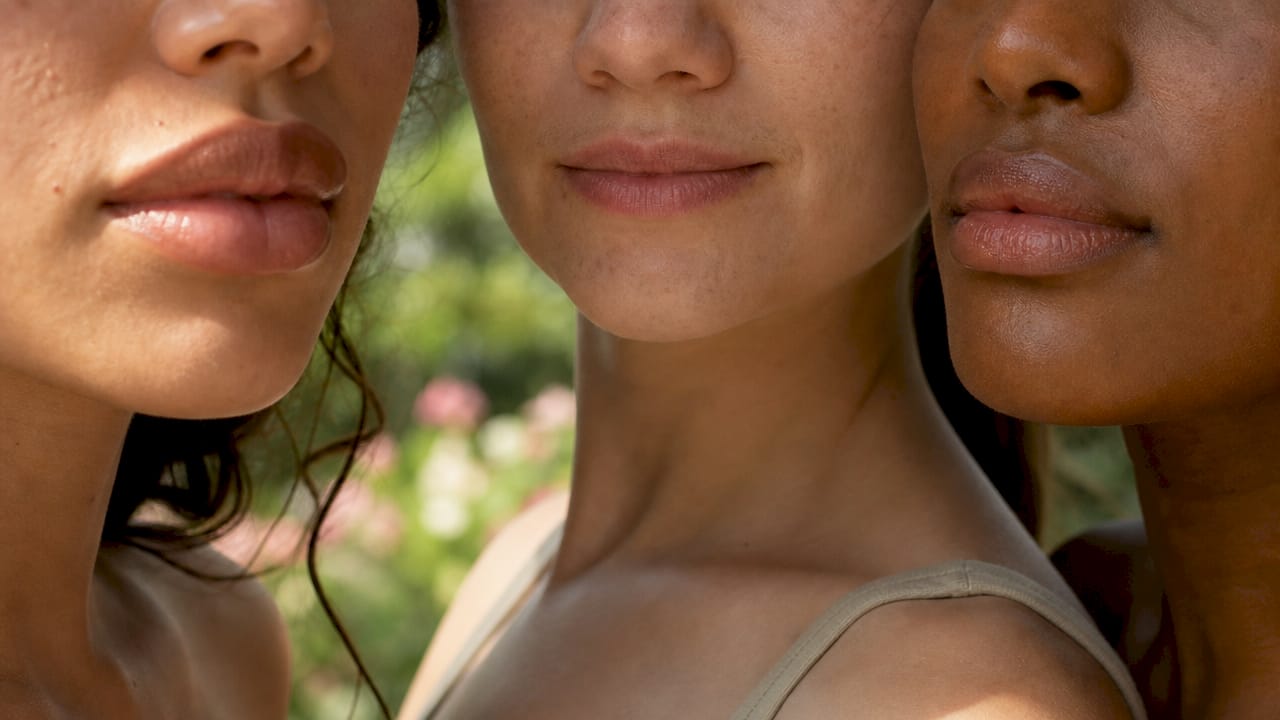
Thin lips have less vertical height and volume. They are a natural characteristic, especially common in women of Northern European heritage, and not a flaw to be corrected. Enhancement works best when it builds confidence rather than chasing heavy volume trends.
Wide lips
Wide lips extend toward or beyond the pupils when viewed straight on. They suit bold color well and benefit from contouring at the corners to refine proportion.
Heart-shaped lips
Heart-shaped lips have a pronounced Cupid’s bow on the upper lip and a fuller lower lip. The upper lip dips at the center, creating a heart silhouette. This shape holds definition well but can appear more angular with age.
Cupid’s bow lips
Cupid’s bow lips share the double-peaked upper lip of heart-shaped lips but with a more symmetrical, even arch. The bow is the defining feature. Liner work along this curve creates strong visual impact.
Asymmetrical lips
Asymmetrical lips have uneven volume or height between the left and right sides. This is extremely common and often becomes more noticeable after 40 as bone structure shifts subtly.
Downturned lips
Downturned lips have corners that angle slightly downward, which can create a resting expression that reads as serious. Targeted liner and highlight techniques at the corners lift the appearance without any treatment.
Heavy upper or lower lip
Some women naturally carry more volume in one lip than the other. A heavier lower lip is more common. Balancing techniques, both in makeup and in aesthetic medicine, focus on proportion rather than adding overall volume.
Round lips
Round lips have a soft, curved shape without sharp peaks or angles. They suit glossy finishes particularly well, as gloss amplifies the natural curve.
Small lips
Small lips are compact in both width and height. Overlining slightly beyond the natural border, using a liner close to the natural lip color, creates the appearance of a larger lip without looking artificial.
2. How aging after 40 changes lip shape and volume
Three main lip aging morphotypes capture the most common ways lips change after 40: devolumized, central-heavy, and chapped or disorganized. Recognizing your morphotype guides every product and treatment decision you make.
The devolumized morphotype shows overall volume loss across the entire lip. The vermillion border becomes less distinct, and the lip appears flatter and thinner than it did in earlier decades.
The central-heavy morphotype retains volume in the center of the lips but loses definition at the edges. The result is a lip that looks uneven or slightly puffed in the middle while the corners thin out.
The chapped or disorganized morphotype presents with surface texture changes, vertical lip lines, and a loss of smooth contour. This type benefits most from hydration-focused care alongside any contouring approach.
Upper lip eversion and projection decline noticeably after 40. This means the upper lip rolls inward slightly, reducing its visible surface area and softening the Cupid’s bow definition.
- Volume loss affects the upper lip more than the lower lip in most women
- The vermillion border blurs, making liner application less precise without preparation
- Perioral lines (vertical lines above the lip) deepen and can cause lipstick to bleed
- Facial bone changes create subtle asymmetries that were not present at 30
Pro Tip: Apply a lip primer or a thin layer of concealer along the vermillion border before lining. This sharpens the edge and prevents color from bleeding into perioral lines.
Improving skin elasticity around the mouth supports lip definition from the outside in. Collagen-supporting skincare applied to the perioral area slows the rate at which the border softens.
3. Best lip care and enhancement strategies for different lip types after 40
The most effective approach for mature lips combines daily hydration, targeted makeup technique, and, where chosen, subtle aesthetic treatment. Restoring definition rather than just adding volume is the priority for women over 40.
Daily care essentials
Hydration is the foundation of every lip type. Dry lips exaggerate lines and make color application uneven. A nourishing lip balm with ingredients like shea butter or hyaluronic acid applied morning and night maintains the lip surface. Perioral rejuvenation, treating the skin around the lips alongside the lips themselves, produces the most natural-looking results.
Makeup techniques by lip type
- Thin lips: Use a nude liner just outside the natural border, then fill in with a medium-toned lipstick. Avoid very dark shades, which reduce apparent volume. The step-by-step lining guide from Lumeracosmetica covers this in detail.
- Downturned lips: Line slightly above the natural corner on each side. Apply a small dot of highlight at each corner to lift the visual line.
- Asymmetrical lips: Use liner to even the higher side down slightly rather than building the lower side up. This creates a more balanced result.
- Devolumized morphotype: Focus on the Cupid’s bow. Redefining this peak restores the youthful shape more effectively than adding overall color volume.
- Chapped or disorganized morphotype: Exfoliate gently once a week. Apply a hydrating treatment overnight. Skip matte formulas, which emphasize texture.
Pro Tip: A lip contouring technique using a liner one shade deeper than your lipstick at the outer corners and a lighter shade at the center bow creates dimension without any product beyond what you already own.
Aesthetic treatments work best when tailored to individual facial proportions and the specific aging morphotype. A thorough consultation, typically 30–60 minutes, identifies which areas need definition versus volume before any treatment begins. Women who seek celebrity-inspired shapes often get better results when specialists redirect toward personalized, sustainable aesthetics instead.
The best makeup tips for mature lips from Lumeracosmetica address each of these scenarios with product-specific guidance.
4. How to identify your lip type and morphotype
Identifying your lip type at home takes less than five minutes and requires only good lighting and a mirror. Lip shape varies significantly with ethnic background and facial structure, so the goal is to understand your own proportions rather than compare against a single standard.
Step-by-step self-assessment
- Stand in natural daylight or under a neutral white light. Avoid warm bathroom lighting, which softens shadows and hides definition.
- Relax your face completely. Do not smile or purse your lips.
- Observe the upper lip first. Does it have a clear Cupid’s bow, a straight edge, or a rounded curve?
- Check the lower lip. Is it fuller than the upper, equal, or thinner?
- Look at the corners. Do they sit level, turn up, or angle down?
- Assess the vermillion border. Is it sharply defined or soft and blurred?
- Note any asymmetry between the left and right sides.
For morphotype identification, ask yourself whether you have lost volume overall (devolumized), retained center volume but lost edge definition (central-heavy), or developed surface texture and lines (chapped or disorganized). Most women over 40 show features of more than one morphotype.
| Lip type or morphotype | Key visual feature | Best enhancement focus |
|---|---|---|
| Full lips | High volume, defined border | Maintain hydration, preserve definition |
| Thin lips | Low vertical height | Subtle overlining, medium tones |
| Heart-shaped | Pronounced Cupid’s bow | Highlight the bow, balance lower lip |
| Asymmetrical | Uneven left/right volume | Liner correction, not volume addition |
| Devolumized morphotype | Overall flatness, blurred border | Redefine vermillion, restore Cupid’s bow |
| Central-heavy morphotype | Center volume, thin corners | Blend and balance toward corners |
| Chapped/disorganized morphotype | Surface lines, uneven texture | Hydration, exfoliation, avoid matte |
A professional consultation is worth pursuing when asymmetry is significant or when you want to explore aesthetic treatments. Specialists assess facial proportions, bone structure, and aging state together to recommend approaches that hold up over time.
Key takeaways
Knowing your lip type and aging morphotype is the single most effective way to choose products and techniques that deliver real results for mature lips.
| Point | Details |
|---|---|
| Lip types are diverse and personal | Over 10 natural shapes exist; no single ideal applies to all women or ethnicities. |
| Aging follows three morphotypes | Devolumized, central-heavy, and chapped/disorganized each need a different care approach. |
| Definition matters more than volume | Restoring the vermillion border and Cupid’s bow creates more natural results than adding bulk. |
| Makeup technique is powerful | Liner, highlight, and color choice can reshape the appearance of any lip type without treatment. |
| Consult before treating | A 30–60 minute consultation tailored to your anatomy produces safer, more lasting outcomes. |
What I’ve learned about mature lips that most beauty advice gets wrong
The conversation around lip beauty for women over 40 is dominated by volume. Add more, fill more, plump more. After years of observing how mature lips actually respond to products and techniques, I find that obsession with volume misses the point almost entirely.
The women who look most naturally beautiful after 40 are not the ones with the fullest lips. They are the ones with the clearest lip definition. A sharp vermillion border and a visible Cupid’s bow read as youthful far more reliably than sheer size does. When I see a mature woman with a well-lined, hydrated lip in a medium tone, the result is always more striking than heavy filler that erases the natural contour.
Thin lips deserve a specific mention here. The pressure to plump thin lips into something they were never meant to be is real, and it produces results that look out of place on the face. Thin lips are a natural trait. The right liner and color choice can make them look polished and intentional without changing their fundamental character.
The other thing most guides skip is the perioral area. Treating the lips in isolation while ignoring vertical lip lines and skin laxity around the mouth is like painting one wall in a room. The result draws attention to everything you did not address. Hydration, gentle exfoliation, and skincare applied to the full perioral zone make every lip product perform better.
My honest recommendation: spend one week learning your lip type and morphotype before buying a single new product. The self-assessment takes minutes. What you learn will save you money and frustration.
— Rebecca
Lumeracosmetica’s resources for mature lip beauty
Lumeracosmetica has built a full library of guides and products specifically for women navigating lip changes after 40. The focus is on natural enhancement, not dramatic transformation.

Whether you are working with thin lips, a devolumized morphotype, or simply want sharper definition, the Lumeracosmetica lip care collection covers the full range of needs. Detailed how-to guides walk through lining, contouring, and color selection for every lip shape and aging pattern. Products are selected with mature skin in mind, prioritizing hydration and pigment that stays true without bleeding. Visit Lumeracosmetica to find the guide and the products that match your lip type.
FAQ
What are the most common types of lips?
The most common lip shapes include full, thin, wide, heart-shaped, Cupid’s bow, and asymmetrical. Over 10 recognized natural variations exist, each with distinct features that influence how makeup and treatments perform.
How do I identify my lip type at home?
Stand in natural daylight, relax your face, and observe your upper lip shape, lower lip volume, corner angle, and vermillion border clarity. Comparing these features against the main lip shape categories helps you identify your type in minutes.
What happens to lip shape after 40?
After 40, lips typically lose volume, the vermillion border softens, and the upper lip loses eversion and projection. These changes follow three main aging morphotypes: devolumized, central-heavy, and chapped or disorganized.
Is lip filler the best option for mature lips?
Lip filler is one option, but subtle, anatomy-informed treatments that restore definition rather than add bulk produce the most natural results for women over 40. Makeup techniques and daily hydration often achieve significant improvement without any treatment.
Do thin lips need to be enhanced?
Thin lips are a natural characteristic, not a problem to fix. Enhancement is a personal choice and works best when it builds confidence rather than conforming to volume trends. A well-chosen liner and lipstick shade can define thin lips beautifully without overlining.