

Red Lipstick Types for Women 30–60: Find Your True Red in 3 Simple Checks

If you want a red that almost never fails, start with a balanced true red, or reach for a blue-red if you want maximum contrast against your teeth and skin. From there, the decision comes down to three things: your undertone, the finish you can commit to wearing, and how many hours you need it to last.
TL;DR:
- Blue-based reds brighten skin and teeth, making them ideal for cool undertones, while warm reds enhance golden or olive complexions.
- Satin finishes offer the most versatility and forgiveness, making them a safe choice for testing undertone and comfort preferences before committing.
- Swatch on the inner wrist in daylight and use vein and jewelry tests to identify your undertone and choose reds that flatter your natural coloring.
- Long-wear liquid formulas provide the best durability but can feel drying, whereas hydrating balms or oils suit casual days but require frequent reapplication.
- Creating a lipstick application routine with exfoliation, lining, layering, and setting can significantly improve longevity and appearance of red lips.
Table of Contents
- Red Lipstick Types by Undertone: Cool, Warm, and True Reds
- Matte, Satin, Gloss, or Stain: How Finish Changes a Red
- How to Match Red Lipstick to Your Skin Tone
- How to Choose the Right Red Lipstick: A Buying Checklist
- How to Apply Red Lipstick So It Lasts
- Fixing the Most Common Red Lipstick Mistakes
- Why Trust This Red Lipstick Guide
- Best Red Lipstick Brands and Their Signature Shades
- What Red Lipstick Actually Costs
- What Changes About Red Lipstick as You Get Older
- Meet the Luméra Perfect Kiss Lipstick
- Sources
Red Lipstick Types by Undertone: Cool, Warm, and True Reds
Every red lipstick belongs to one of three undertone families, and learning to spot them on sight will save you more wasted purchases than any other single skill. Cool reds lean blue or pink at the base. Warm reds lean orange or brick. True reds, sometimes called neutral reds, sit in the middle and borrow a little from both.
Cool, blue-based reds tend to make teeth look whiter and skin look brighter almost instantly, which is why so many editors default to them for evening looks and photos. Think cherry, cranberry, or a red with a visible violet cast when you swatch it on the back of your hand. Warm, orange-based reds read closer to tomato, brick, or poppy. They flatter golden and olive undertones by echoing the skin’s own warmth instead of fighting it, but on very cool or pale skin they can occasionally emphasize sallowness. True or neutral reds split the difference. They contain balanced amounts of blue and yellow pigment, which is exactly why LipstickQueen’s guide to universal reds points to them as the most broadly flattering option when you genuinely don’t know your undertone yet.
Spotting the undertone family before you buy is easier than it sounds:
- Cool reds often carry words like “cherry,” “cranberry,” “ruby,” or “blue red” in the product name or description.
- Warm reds usually show up as “poppy,” “brick,” “tomato,” “coral red,” or “orange red.”
- True reds are frequently marketed simply as “classic red,” “signature red,” or “the perfect red.”
- Swatch on the inner wrist, not the back of the hand. Skin there is closer in tone to your lips and shows the undertone more honestly.
- Check the tube in daylight, not under indoor yellow lighting, which shifts everything warmer than it actually is.
Personal color analysis, the method built on classic color theory, gives you an even faster shortcut. It groups people into seasons, cool winters and summers, warm springs and autumns, and matches each to a family of reds that harmonizes with their natural coloring. You don’t need a professional consultation to use the logic. If silver jewelry has always looked better on you than gold, you’re probably cool-toned and belong in the blue-red camp. If gold has always won, warm reds are your faster path to a flattering match.
Matte, Satin, Gloss, or Stain: How Finish Changes a Red
The finish you pick changes more than shine. It changes how the color itself reads on your lips, which is why two people can wear the “same” red and get completely different results.
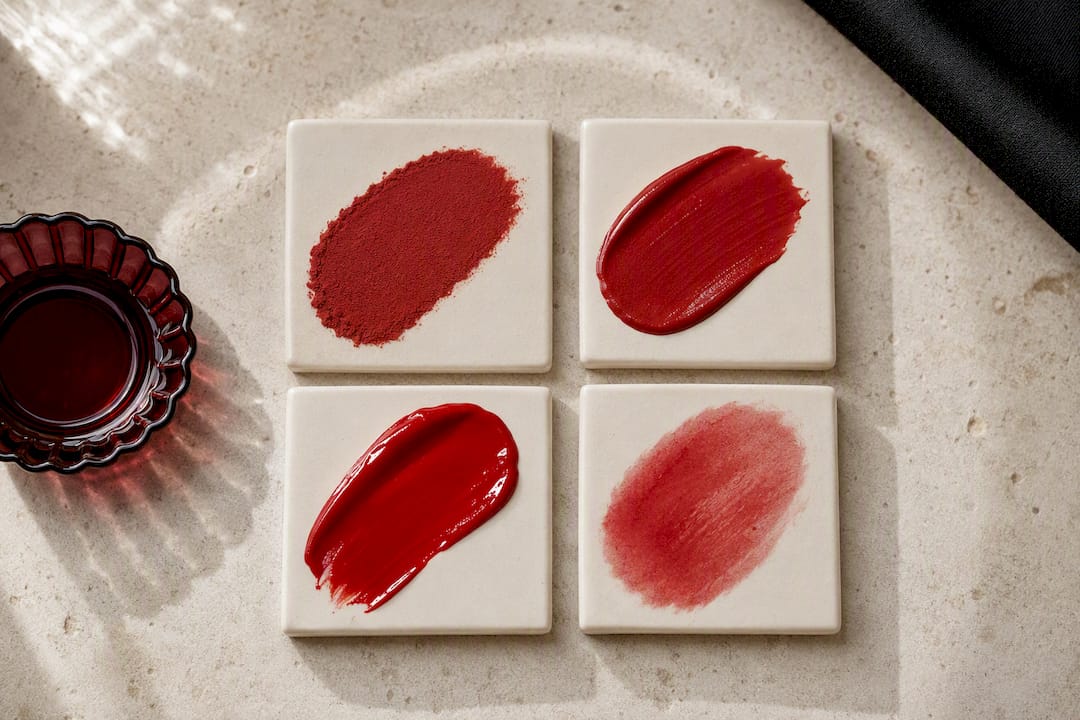
Matte finishes intensify a red’s undertone because there’s no light bouncing off a wet or glossy surface to soften it. A blue-red in matte looks bluer and more dramatic. A warm red in matte looks more saturated and brick-like. That intensity is a strength for bold, all-day statement looks, but it also means an ill-matched undertone shows up more obviously in matte than in any other finish, according to guidance from LipstickQueen. Satin softens the same undertone with a slight sheen, which is part of why satin formulas dominate the category. Satin finishes now account for roughly 43.41% of the lipstick finish market, largely because they forgive small undertone mismatches better than a full matte does. Gloss and sheer stains soften undertone even further. A gloss red can look almost universally wearable because the shine scatters light and blurs the line between warm and cool.
Formula affects longevity as much as finish affects color. Liquid lip stains and long-wear liquid mattes tend to survive meals and coffee the longest but can feel tight or drying by hour six. Cream and satin bullets sit in the middle: comfortable, moderate wear, some transfer. Balms and tinted oils barely transfer at all but need reapplication more often, which makes them a better fit for casual days than for a wedding you’re photographed at for six hours straight.
- Matte: boldest color payoff, longest wear on average, least forgiving of dry lips or undertone mismatches.
- Satin: the safest all-around choice, forgiving on undertone, moderate longevity.
- Gloss and sheer stain: most flattering across undertones, shortest wear time, best for daytime or casual looks.
- Liquid stain: excellent transfer resistance, can feel drying without a balm underneath.
- Balm and tinted oil: most comfortable and hydrating, needs the most frequent touch-ups.
Pro Tip: If you’re torn between a warm and cool red in the same formula, buy the satin version first. It’s the closest thing to a universal test drive before you commit to a full matte in that shade.
For a closer look at how these textures compare side by side, Lumeracosmetica’s guide to lipstick finishes breaks down the visual differences with photos.
How to Match Red Lipstick to Your Skin Tone
Matching red to your actual skin tone takes three minutes and none of it requires guessing. Do these checks in order and you’ll walk into any store, or open any online shade guide, already knowing which third of the wall to shop.
- Check your veins in natural light. Look at the inside of your wrist near a window. Blue or purple veins usually mean a cool undertone. Green veins usually mean warm. Veins that look blue-green or hard to categorize usually mean neutral.
- Try the jewelry test. If silver and platinum have always flattered you more than gold, you’re likely cool-toned. If gold makes your skin glow and silver looks flat against it, you’re probably warm. If both work equally well, you’re neutral.
- Hold white paper next to your face. Cool undertones make skin look slightly pink or rosy by comparison. Warm undertones make skin look more golden or yellow. Neutral undertones show very little shift either way.
Once you know your undertone, the shade math gets simple.
Fair skin, cool undertone. Blue-based reds are your strongest category, and makeup editors consistently point cool, fair complexions toward them because the blue base brightens the whole face instead of competing with pink undertones already present in the skin. Cherry, cranberry, and true blue-red all work. Avoid orange-heavy warm reds here; on fair cool skin they tend to look slightly muddy rather than vibrant. A satin or gloss finish in a blue-red is one of the most reliably flattering combinations that exists in this category.
Fair skin, warm undertone. You have more room than you’d think. Soft coral-reds and lighter warm reds work well without overwhelming a lighter complexion, while a true red in a satin finish stays balanced and doesn’t tip too orange.
Medium and olive skin. This is where warm, tomato, and brick reds genuinely shine, since olive undertones already carry green and gold, and a warm red plays into that instead of clashing with it. Orange-reds and true reds both read beautifully here. If your olive skin leans slightly cool (some do), a true red or a muted berry-red bridges the gap better than a heavily orange shade would.
Deep skin tones. Berry, wine, and pink-leaning reds tend to be the most universally recommended direction for deep complexions, since these shades have enough pigment saturation to show up richly rather than fading into the skin. A deep, near-black-red matte can look stunning for evening, while a brighter berry-red in satin works beautifully for daytime. Editors specifically call out berry and pink-leaning reds as strong options for deeper skin because they add dimension rather than flattening it against darker skin’s natural depth, a point echoed in Allure’s shade-matching guide.
If you want to refine further, color-season analysis adds one more layer of precision. Winters, who usually have high contrast between hair, eyes, and skin, tend to favor bright, blue-based reds. Springs, with warmer and lighter coloring, do best in light, warm reds. Summers, who run cool and muted, look best in soft, muted berry-reds rather than anything too bright or too orange. Autumns, with rich warm coloring, tend to glow in brick and terracotta reds. This seasonal framework comes from classic color theory adapted specifically for lip color, and it’s a genuinely useful tiebreaker when the undertone tests above leave you between two options.
Women with mature, fuller lower-face volume or thinner lips as skin changes with age often find that blue-based reds in a hydrating satin formula strike the best balance between definition and comfort, a combination Lumeracosmetica covers specifically for women over 40.
How to Choose the Right Red Lipstick: A Buying Checklist
Before you add a red to your cart, in a store or online, run through this checklist in order. Skipping straight to color and ignoring the rest is the single most common reason a “perfect” red ends up in a drawer.
- Undertone match: cool, warm, or true, based on the vein and jewelry tests above.
- Finish: matte for drama and longevity, satin for versatility, gloss or balm for comfort and daytime wear.
- Intended wear time: a lunch date needs different staying power than a wedding you’re photographed at for eight hours.
- Hydration needs: if your lips are naturally dry or you’re over 40, a fully matte, non-hydrating formula can emphasize texture and fine lines.
- Sensitivity: check the ingredient list if you have a history of reactions, particularly to dyes, fragrance, or certain waxes.
Swatching correctly matters as much as the checklist itself. Test on your lips whenever possible, not just the back of your hand, because lip skin has a different texture and pigment than hand skin and the color can shift noticeably between the two. If you’re shopping in person, swatch in daylight near a window or door rather than under the store’s overhead lighting. If you’re shopping online, look for swatch photos on multiple skin tones rather than relying on a single model or the tube’s cap color, which is often more saturated than the actual product.
A wear test beats a swatch every time. Apply the color, then go about a normal hour or two, eating, drinking, talking, before deciding whether you like it. Colors that look perfect fresh out of the tube sometimes oxidize or shift slightly once they interact with your skin’s natural pH and warmth.

Watch for vague claims on packaging. “Long-wearing” can mean four hours or ten depending on the brand, and “hydrating” formulas vary enormously in how much slip and moisture they actually deliver. According to Elle’s roundup of expert-recommended reds, the smarter approach is judging lipsticks by formula and finish rather than by price point or brand prestige, since budget and luxury formulas both show up on expert lists for good reason: comfort and color accuracy don’t scale neatly with price.
Pro Tip: Keep a small notebook, or a notes app, on your phone with the exact shade names and brands of reds that worked for you. Undertone matching gets dramatically faster once you know two or three “anchor” shades that you can compare new options against.
For formulas specifically built to reduce the trade-off between wear time and comfort, Lumeracosmetica’s piece on non-drying lipstick walks through what ingredients tend to make the biggest difference.
How to Apply Red Lipstick So It Lasts
A red that photographs beautifully at 9 a.m. and still looks intact at 5 p.m. comes down to technique more than product. Follow these steps in order:
- Exfoliate lightly and moisturize first. A gentle lip scrub or a warm washcloth removes flaking skin, and a light balm underneath prevents matte formulas from grabbing onto dry patches.
- Line before you fill. Outline your natural lip shape with a liner close to your lipstick’s undertone, then fill in the entire lip with the same liner. This creates a base that helps the color grip and slows fading from the inside out. Lumeracosmetica’s lip liner technique guide covers the exact motion for a clean edge without a steady-hand background.
- Apply the lipstick itself, using a slim bullet directly for precision or a lip brush if you want more control over the cupid’s bow. Liquid formulas usually come with a doe-foot applicator built for buildable, precise coverage.
- Blot with a single tissue, pressing lips together once, then apply a second thin layer. This “blot and layer” method roughly doubles wear time compared to one thick coat.
- Set with translucent powder through a tissue if you need maximum longevity for a long event, gently pressing rather than rubbing.
For touch-ups, carry the liner more than the lipstick itself. A quick trace along any faded edges restores the shape faster than reapplying full color. If the shade has feathered into fine lines, a cotton swab dipped in micellar water can clean the edge without disturbing the rest of the color, then a small dab of concealer resets the border. Removing red without staining your skin or a white pillowcase comes down to oil: a cleansing balm or micellar water breaks down pigment far more effectively than soap and water, which tends to smear it instead of lifting it.
Fixing the Most Common Red Lipstick Mistakes
Bleeding into fine lines is almost always a prep problem, not a product problem. Lining first and pressing a thin layer of translucent powder around the outer edge before applying color creates a barrier most reds won’t cross. If a red reads too warm or too cool once it’s on, you don’t need to buy a new tube. Dabbing a small amount of a cool-toned clear gloss over a too-warm red mutes the orange, while a warm gloss layered over a too-cool red softens the blue.
- Overly cakey matte finish: apply a balm five minutes before lipstick, let it absorb, then apply.
- Red that ages the face: pair with soft, neutral blush rather than none at all, and keep eye makeup softer than the lip.
- Feathering: liner plus a light powder press before lipstick application.
Why Trust This Red Lipstick Guide
This guide reflects the editorial focus of Rebecca, whose writing centers on red lipstick and lip color choices for women roughly 30 to 60 navigating changing lip texture, comfort needs, and personal style. The client specializes specifically in lip products designed for mature women, with formulas built around comfort and hydration rather than chasing every seasonal trend.
Best Red Lipstick Brands and Their Signature Shades
You don’t need a single go-to brand for red, since the best approach mixes formulas based on occasion rather than brand loyalty. Drugstore lines have made real gains in pigment and formula quality over the past several years, closing much of the gap with prestige options, and editor roundups increasingly reflect that shift by mixing price points rather than defaulting to luxury. What separates a great red from a forgettable one usually isn’t the logo on the tube. It’s whether the specific formula matches your undertone, your comfort needs, and how long you actually need the color to last.
Some brands built entire reputations on a single, near-iconic red shade, the kind of color people request by brand name rather than by number. Others built their reputation on range, offering enough undertone variety within one line that a shopper can find both a blue-red and a brick-red without switching brands entirely. Formulas focused on mature or drier lips increasingly emphasize hydrating bases, since matte finishes in particular have historically underserved skin that needs more moisture to look smooth rather than settling into fine lines.
The smartest way to shop brands isn’t by prestige tier. It’s by matching a brand’s known strength (long wear, hydration, precise undertone range) to your specific priority from the checklist above.
What Red Lipstick Actually Costs
Red lipstick spans an enormous price range, and cost doesn’t reliably predict how well a shade works for you. Drugstore reds typically run under $15 and have improved significantly in pigment payoff and formula comfort in recent years, making them a genuinely smart place to test an undertone family before committing to something pricier. Mid-range options, often between $20 and $35, tend to offer more finish variety within a single shade name, letting you buy the same red in matte and satin without hunting across brands.
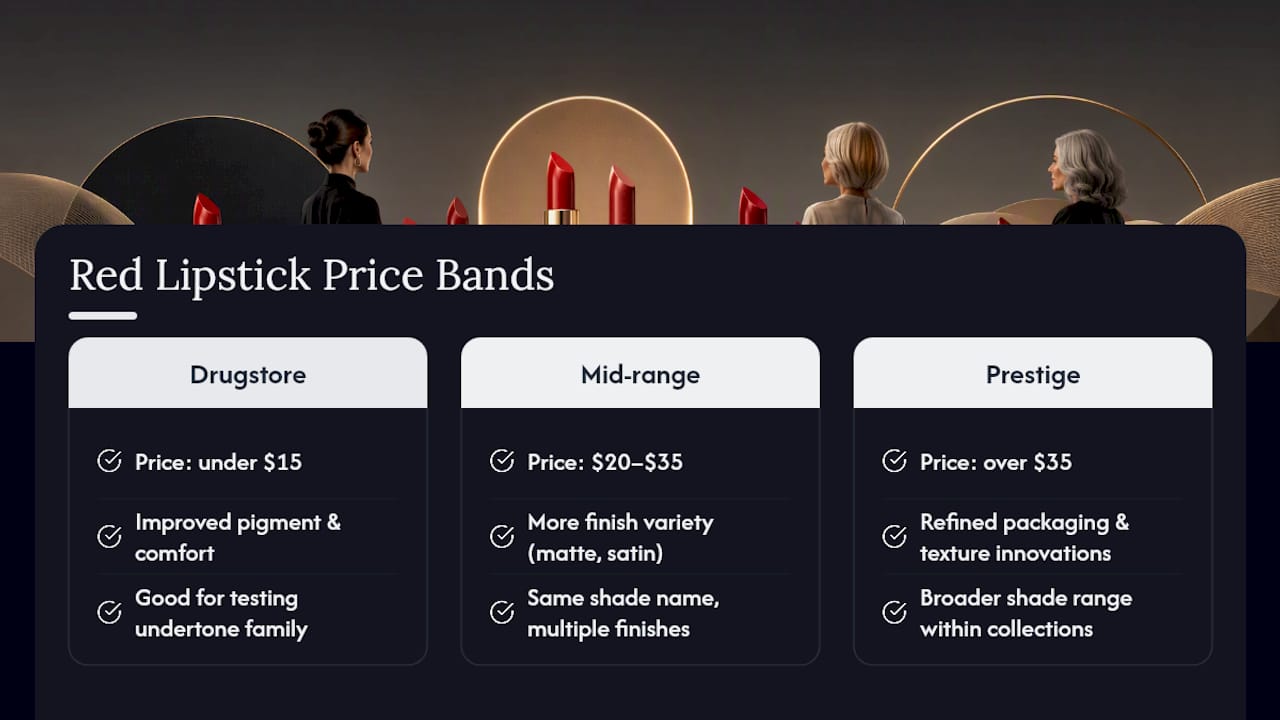
Prestige and luxury reds can run well past $35, sometimes considerably more, and the premium usually buys you refined packaging, a broader shade range within one collection, or a specific texture innovation rather than dramatically better pigment. Expert roundups back this up directly: Elle’s list of expert-recommended reds mixes budget and luxury picks side by side, reinforcing that formula and finish matter more than the price tag stamped on the box.
A practical budget strategy: spend less while you’re still identifying your undertone family, then invest more once you know exactly which shade direction, cool, warm, or true, consistently works for you. Buying an expensive red before you’ve confirmed your undertone is the single most common way people end up with a beautiful lipstick that never leaves the drawer.
What Changes About Red Lipstick as You Get Older
Lips change with age, and the reds that worked at twenty-five don’t always work the same way now. Comfort and hydration matter more than they used to, and a slightly softer, blue-leaning red often flatters more than the bright orange-reds that once looked great. My honest recommendation: keep one hydrating true red in your bag as a reliable starting point, then branch out once you know your undertone.
— Rebecca
Meet the Luméra Perfect Kiss Lipstick
Everything in this guide, undertone matching, finish trade-offs, and comfort over an entire day, points toward one practical takeaway: the right red should feel as good in hour six as it did in minute one. The Luméra Perfect Kiss Lipstick was built around that exact priority, pairing rich color payoff with a skincare-infused formula meant to feel comfortable through long wear rather than tightening or settling into fine lines.
To decide if it fits your undertone, run through the vein and jewelry tests from the matching section above before you pick a shade, and lean toward the finish that matches your priority: a fuller matte look for evenings, a softer satin for everyday wear. If hydration has been the deciding factor keeping you from wearing matte reds in the past, this is the kind of formula worth testing first. Visit the Luméra Perfect Kiss product page to see the current shade range and find your starting red.
Sources
The color logic in this guide draws heavily on Byrdie’s breakdown of color theory and red lipstick, which explains how color seasons map onto specific red undertones in more depth than a single article can cover. Allure’s editor-tested picks by skin tone offer real-world shade recommendations from people who wear these formulas daily, useful if you want specific swatches to compare against your own skin. LipstickQueen’s guide to cool versus warm reds goes deeper into how finish interacts with undertone than space allowed here. Finally, Elle’s expert roundup of the best reds is worth a look if you want a wider spread of price points and formulas tested side by side.
- How To Use Color Theory To Find Your True, Perfect Red Lipstick
- 11 Best Red Lipsticks Allure Editors Actually Wear on Repeat
- The 7 Best Red Lipsticks of 2026, According to Experts


