Blue-based red lipstick: Flattering looks for women 40+

TL;DR:
- Blue-based reds have cool undertones, making teeth look whiter and skin more luminous.
- Your skin undertone determines if a blue-red complements or clashes with your complexion.
- Confidence and personal preference matter most when choosing the right lipstick shade.
Finding a red lipstick that truly works for you is harder than it looks. Many women over 40 assume all reds are created equal, but undertone is everything. A blue-based red can make your complexion glow, your teeth look brighter, and your whole look feel polished and intentional. Get it wrong, though, and the same shade can wash you out or clash with your natural coloring. This guide breaks down exactly what blue-based red lipstick is, who it suits, and how to find the one that makes you feel like the most confident version of yourself.
Table of Contents
- Understanding blue-based red lipstick
- The science of undertones: Who should wear blue-based reds?
- Benefits and drawbacks of blue-based red lipstick for women 40+
- How to choose and apply blue-based red lipstick for mature skin
- The uncomfortable truth about blue-based reds for mature women
- Explore blue-based reds and expert support with Luméra Cosmetica
- Frequently asked questions
Key Takeaways
| Point | Details |
|---|---|
| Blue-based reds defined | These lipsticks have cool undertones, making teeth appear whiter and skin brighter. |
| Not universally flattering | Blue-based reds can cause sallow effects on warm skin and are not ideal for everyone. |
| Test before committing | Swatching and vein checking provide the most reliable results for finding your best shade. |
| Mature skin benefits | Blue-based reds can refresh a mature complexion, but individual undertone testing is key. |
| Expert advice matters | Consulting guides and professionals helps avoid common pitfalls and maximizes your results. |
Understanding blue-based red lipstick
Not all reds sit in the same place on the color wheel. Every red lipstick leans either warm or cool, and that lean changes everything about how it reads on your lips and against your skin.
A blue-based red lipstick has a cool undertone. That means the red pigment is mixed with blue rather than yellow or orange, pushing it toward a true red, a berry red, or a deep cherry. In contrast, an orange-based red has warm undertones, giving it a tomato, brick, or rust quality. The two can look similar in the tube, but on the lips, they behave very differently.
Here is what makes undertone so important for mature skin:
- Skin tone shifts over time. As we age, skin often loses some of its warm, peachy flush and can take on more yellow or gray tones. The right lipstick undertone can counteract this.
- Cool reds create contrast. A blue-based red pulls attention to the lips and away from any uneven skin tone around the mouth.
- Teeth appear whiter. The blue pigment in cool reds counter yellow teeth visually, making your smile look brighter without any whitening treatment.
- Orange-based reds can age. On skin that already skews yellow or sallow, a warm red can intensify that effect rather than lift it.
Understanding where your lipstick sits on the warm-to-cool spectrum is a foundational skill. Our lipstick color guide walks through the full range if you want to see how different families compare side by side.
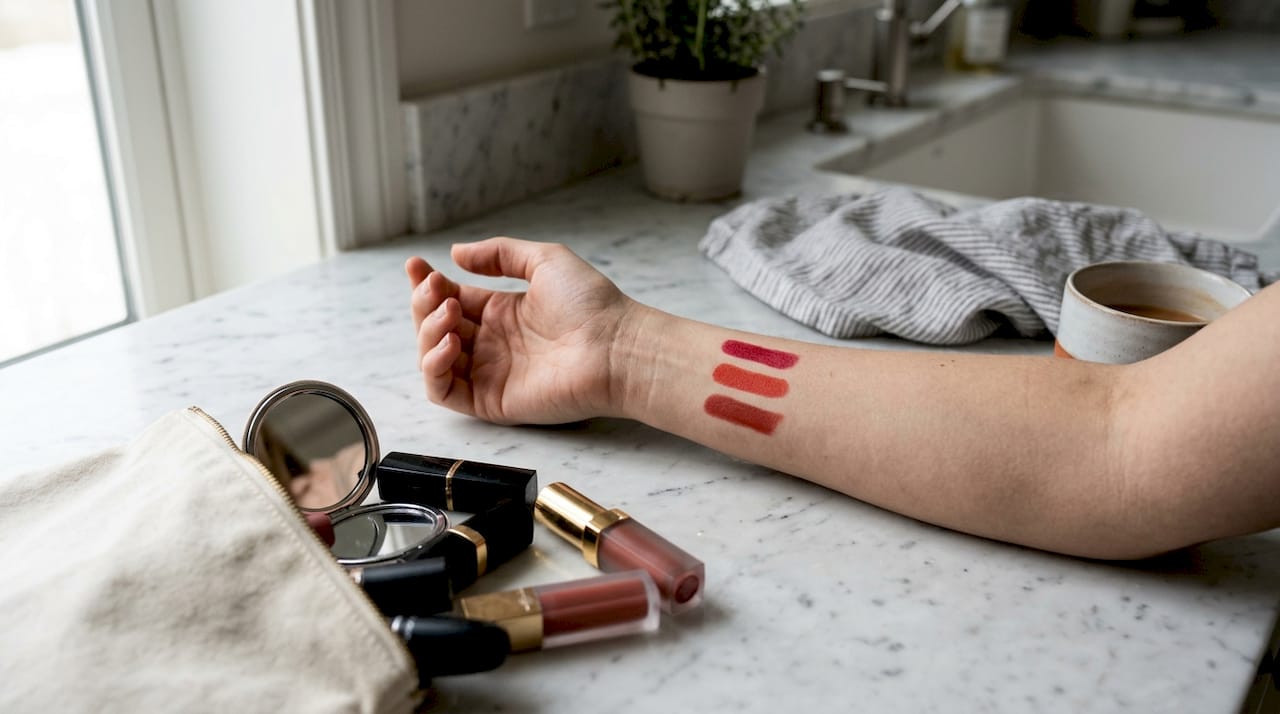
Pro Tip: Hold a lipstick swatch next to a piece of white paper. A blue-based red will look distinctly cooler and more jewel-toned. An orange-based red will look warmer and earthier by comparison.
Once you can see the difference, you cannot unsee it. That is actually a good thing, because it means every future lipstick purchase becomes a more informed decision.
The science of undertones: Who should wear blue-based reds?
Knowing what a blue-based red is and knowing whether it suits you are two different things. Let’s get specific.
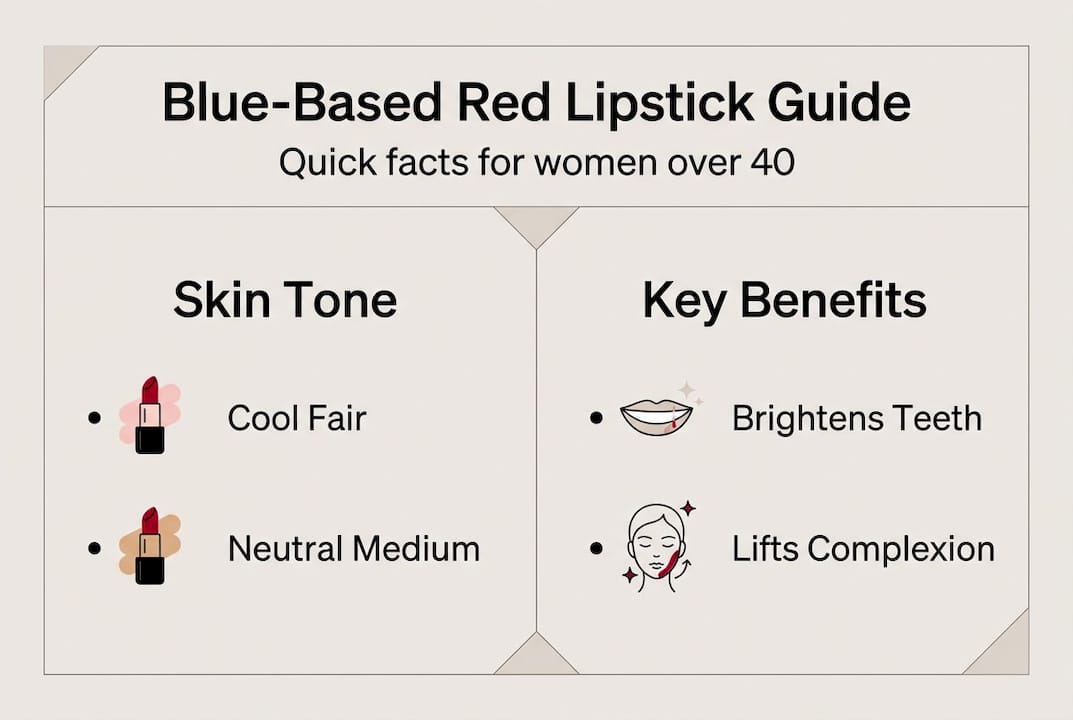
The most reliable way to identify your own undertone is the vein test. Look at the inside of your wrist in natural daylight. Blue or purple veins point to a cool undertone. Green veins suggest warm. A mix of both means you are neutral, which is genuinely the most flexible category.
Here is how different skin tones typically respond to blue-based reds:
| Skin tone | Undertone | Blue-based red result |
|---|---|---|
| Fair with pink or neutral base | Cool or neutral | Brightening, classic, very flattering |
| Medium with olive base | Warm or neutral | Can work beautifully with the right depth |
| Deep with cool or neutral base | Cool or neutral | Rich, striking, highly complementary |
| Warm with yellow or golden base | Warm | High contrast; may create a sallow effect |
For women dealing with rosacea or persistent redness, the picture gets more nuanced. Red lipstick color theory suggests that cool reds can sometimes amplify facial redness rather than balance it, because the eye is drawn to the lip color and then notices the similar tones in the skin. In these cases, a deeper or more muted blue-red may work better than a bright one.
Here is a simple numbered process for figuring out where you land:
- Do the vein test in natural light, not under fluorescent bulbs.
- Think about whether gold or silver jewelry tends to suit you better. Silver favors cool undertones; gold favors warm.
- Consider how your skin reacts to sun. Cool-toned skin tends to burn and then fade. Warm-toned skin tends to tan more easily.
- Swatch a blue-based red on your lower lip and look at your full face in daylight. Does your skin look lifted or flat?
“Edge cases matter. Rosacea may avoid cool reds; warm skin paired with a blue red creates high contrast that some love and others find unflattering.”
Finding a flattering lipstick color is not about following a rule. It is about understanding your own features well enough to make a confident choice. And if you want guidance on formulas that work specifically for mature lips, our guide to types of lipstick for mature women covers texture, finish, and wear considerations in detail.
Benefits and drawbacks of blue-based red lipstick for women 40+
Let’s be direct about what blue-based reds do well and where they can fall short, especially for women in their 40s and beyond.
The benefits are real and significant:
- Brightening effect. Cool reds create luminosity around the mouth, which can make the whole face look more awake and energized.
- Teeth appear whiter. This is one of the most consistent benefits. The blue pigment creates an optical contrast that makes yellow tones in teeth less visible.
- Classic, polished aesthetic. Blue-based reds have a timeless quality. Think old Hollywood, think Audrey Hepburn. They read as intentional and refined.
- Complexion lift. For women with cool or neutral undertones, a blue-based red can pull the face upward visually, drawing attention to the lips rather than to lines or uneven skin tone.
The drawbacks are equally real:
- Sallow effect on warm skin. Empirical tests over brand claims consistently show that warm-toned women risk looking washed out or sallow when they wear a very cool red.
- Can emphasize facial redness. As noted above, women with rosacea or high natural color in the cheeks may find that a bright blue-red draws the eye to that redness rather than away from it.
- Finish matters more with age. A matte blue-based red can settle into fine lines around the mouth. A satin or cream formula in the same shade will be far more forgiving.
| Feature | Blue-based red | Orange-based red |
|---|---|---|
| Teeth appearance | Looks whiter | Can emphasize yellow |
| Cool undertone skin | Very flattering | May clash |
| Warm undertone skin | Risk of sallow look | Generally more harmonious |
| Classic vs. trendy | Classic | More seasonal |
| Mature lip formula | Cream or satin best | Cream or gloss best |
For more red lipstick tips for women 40+, including how to keep color from bleeding and how to choose the right finish for your lip texture, we have a dedicated resource worth bookmarking. You can also explore types of lipstick colors for mature women to see how blue-based reds compare to other shade families across different skin tones.
How to choose and apply blue-based red lipstick for mature skin
Theory is useful. Practice is better. Here is how to actually find and wear a blue-based red that works for you.
Step-by-step selection process:
- Do the vein test first. Establish your undertone before you shop. This saves time and money.
- Swatch on your actual lips, not your wrist. Lip pigmentation changes the color significantly. Always test on the lips.
- Check in daylight. Store lighting flatters almost everything. Step outside or near a window to see the true effect.
- Look at your full face, not just your lips. Does the shade make your skin look brighter or flatter? Does it draw attention to your eyes or away from them?
- Empirical tests over brand claims always win. A lipstick marketed as universally flattering still needs to prove itself on your specific face.
Application tips for mature lips:
- Prep lips with a light exfoliant and a thin layer of balm at least 10 minutes before applying. Blot the balm before lipstick goes on.
- Use a lip liner in a matching cool tone to define the edges and prevent bleeding. This step is non-negotiable for a clean finish.
- Apply lipstick with a brush for precision. Press, do not drag, to avoid pulling at the lip skin.
- Blot once with a single tissue layer, then apply a second coat for staying power.
- Avoid very matte formulas if your lips have fine lines. A cream or satin finish in the same shade will look more modern and stay more comfortable.
Pro Tip: If you are unsure whether a shade is truly blue-based, hold it next to a pure orange-red. The contrast will be immediately obvious, and you will quickly train your eye to spot the difference without any guesswork.
For more guidance, our tips for choosing red lipstick and choosing lipstick shades resources offer practical frameworks that take the guesswork out of the process entirely.
The uncomfortable truth about blue-based reds for mature women
Here is what most lipstick articles will not tell you: blue-based reds are not a universal solution. The beauty industry loves a clean narrative, and “cool reds brighten everyone” is a very sellable idea. But it is not always true.
We have seen women with warm, golden skin try a blue-based red because a magazine told them it would make their teeth look whiter, and they ended up looking drained. The vein check and swatching process exists precisely because no marketing claim can substitute for what you see on your own face.
What we believe, after years of working with women in their 40s and beyond, is that confidence in a shade matters more than color theory compliance. If a warm red makes you feel electric and a cool red makes you feel uncertain, wear the warm red. Color theory is a starting point, not a rule.
That said, knowing the theory means you can experiment from an informed place rather than a frustrated one. Explore our must-have lipstick shades for women 40+ to see how blue-based reds sit alongside other essential shades worth having in your collection.
Explore blue-based reds and expert support with Luméra Cosmetica
Ready to find the blue-based red that actually works for your skin, your undertone, and your lifestyle? Luméra Cosmetica brings together expert-curated shades and real guidance built specifically for mature women. We do not believe in one-size-fits-all beauty, and our resources reflect that.
From personalized shade recommendations to practical application advice, everything at Luméra Cosmetica is designed to make your choices feel easier and your results feel better. If you are navigating lip care for mature skin specifically, our guide on lipstick tips for mature women is a strong next step. Browse, explore, and find the red that belongs on your lips.
Frequently asked questions
How can I tell if lipstick is blue-based or orange-based?
Swatch the lipstick and compare it to a known warm red. Blue-based reds look cooler and often create an optical effect that makes teeth appear whiter, while orange-based reds look earthier and warmer in tone.
Will blue-based red lipstick suit my warm skin tone?
It can create a striking contrast, but warm skin with blue-red sometimes produces a sallow effect. Always swatch in daylight and assess your full face before committing to the shade.
Is blue-based red lipstick better for mature women?
For women with cool or neutral undertones, blue-based reds can genuinely brighten the complexion and make teeth look whiter. However, blue reds emphasize warmth in warm complexions, so undertone and skin sensitivity should always guide the final choice.
What is the best way to test if a blue-based red suits me?
Empirical tests like swatching directly on your lips and checking your vein color in natural light are far more reliable than relying on brand descriptions or marketing claims alone.