High moisture lipstick: comfort and hydration for mature lips

TL;DR:
- High moisture lipsticks contain nourishing ingredients like shea butter, jojoba oil, and hyaluronic acid.
- For mature lips, hydrating formulas prevent dryness, flaking, and exaggeration of fine lines.
- Proper application includes lip prep, choosing creamy finishes, and layering for lasting comfort.
Not all lipsticks are created equal, and if you’ve ever ended the day with dry, tight lips, you already know this. There’s a widespread belief that lipstick always dries out mature lips, but the real story is more specific. The formula matters enormously, and so do the ingredients and finish. The right lipstick can actually work with your lips rather than against them, delivering color and care at the same time. This article covers exactly what separates a genuinely hydrating lipstick from one that leaves your lips feeling parched, and how to choose, apply, and wear high moisture formulas with confidence.
Table of Contents
- What defines a high moisture lipstick?
- Why moisture matters for women over 40
- How to spot and select hydrating lipsticks
- Applying and wearing high moisture lipstick for best results
- Our take: Choosing comfort and confidence over trends
- Explore lip care with Luméra Cosmetica
- Frequently asked questions
Key Takeaways
| Point | Details |
|---|---|
| Hydration is key | Lipsticks with moisturizing ingredients keep mature lips comfortable and prevent dryness. |
| Finish matters | Creamy or satin finishes deliver more moisture than traditional matte formulas. |
| Ingredient awareness | Reading labels for nourishing components helps select truly hydrating lipsticks. |
| Tailored routines | Layering and preparation maximize both comfort and wear for women over 40. |
What defines a high moisture lipstick?
Building on the introduction’s recognition of confusion, here is what truly separates moisture-rich lipsticks from the rest.
A high moisture lipstick is not just any colored lip product. It is a formula intentionally designed to deliver hydration, comfort, and nourishment alongside pigment. The key difference lies in both the ingredients and the finish. Hydrating lipsticks are identified by ingredients and finishes associated with comfort, including oils, butters, and hyaluronic acid, while avoiding overly drying matte finishes when moisture is the primary goal.
Think of the best high moisture lipsticks as a hybrid between a traditional lip balm and a full-pigment lip color. They smooth on like butter, leave your lips feeling soft hours later, and don’t demand constant reapplication just to maintain comfort.
Key nourishing ingredients to know:
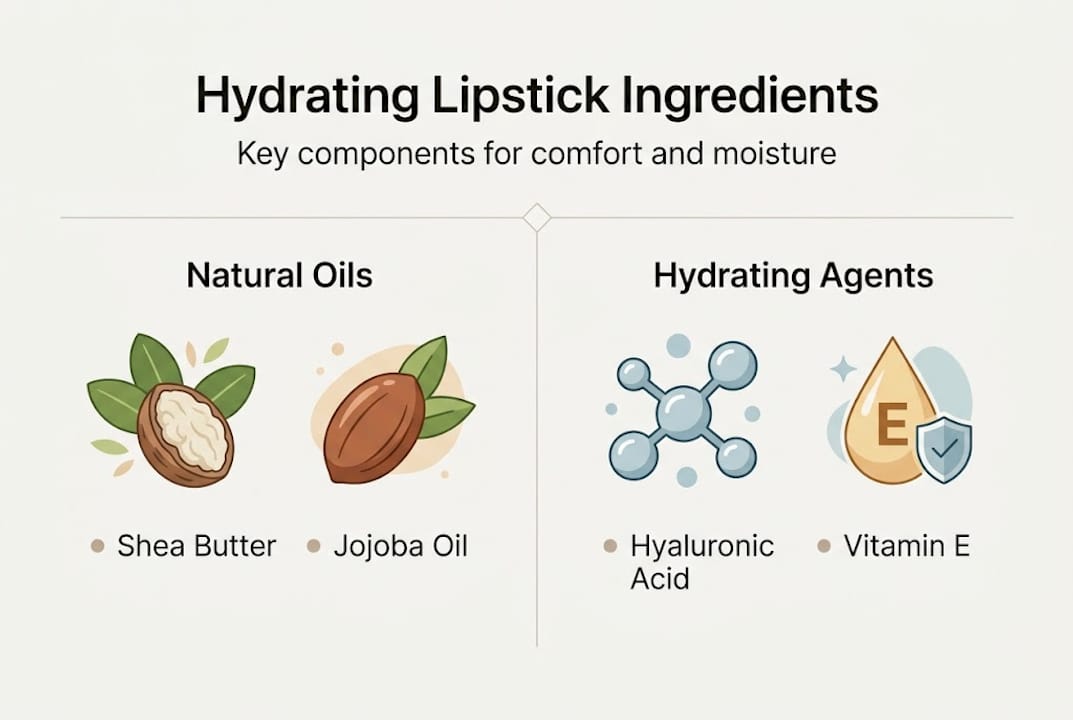
- Shea butter: Rich in fatty acids, shea butter seals in moisture and creates a protective layer on the lip surface, reducing water loss over the course of the day.
- Jojoba oil: A liquid wax that closely mimics the skin’s natural oils. It absorbs easily without feeling greasy and helps keep lips supple.
- Hyaluronic acid: A moisture-binding molecule capable of holding a significant amount of water relative to its size. When applied topically, it draws moisture to the surface of the lips for a plumper, smoother appearance.
- Vitamin E: An antioxidant that supports the skin’s protective barrier and adds a conditioning quality to the formula.
- Castor oil: A thick, occlusive oil that helps lock hydration in place and gives lipstick its characteristic smooth glide.
Primary characteristics of a high moisture lipstick:
- A creamy, satin, or glossy finish rather than a flat matte
- A buttery texture that glides without dragging
- Visible plumping or smoothing effect on the lip surface
- Comfortable wear that does not tighten or feel “set” on the lips
- Ingredient lists featuring oils, butters, waxes, and moisture-binding actives
Moisturizing vs. matte lipsticks: a direct comparison
| Feature | High moisture lipstick | Matte lipstick |
|---|---|---|
| Finish | Creamy, satin, or glossy | Flat, no shine |
| Key ingredients | Oils, butters, hyaluronic acid | Pigments, waxes, minimal oils |
| Comfort level | High, stays soft | Can feel tight or dry |
| Wear on mature lips | Smooths and softens | May accentuate fine lines |
| Hydration over time | Maintains moisture | Can deplete lip moisture |
| Reapplication need | Less frequent | Often more frequent |
The contrast is significant. When you understand what goes into these formulas, choosing becomes much less guesswork. For a broader overview of options designed with mature women in mind, types of lipstick for mature women covers the full range of finishes and formulas worth exploring.
Pro Tip: If you love a bold, highly pigmented look but also want comfort, reach for a satin formula with rich pigment rather than a classic matte. You get the color payoff without sacrificing your lips’ moisture balance.
Why moisture matters for women over 40
After understanding what makes a high moisture lipstick, it’s important to see why these formulas matter particularly for women over 40.
Mature lips behave differently, and that’s not a complaint. It’s simply biology. As estrogen levels shift with age, the skin throughout the body, including the lips, produces less natural oil. The lips become thinner, less elastic, and noticeably more prone to dryness. Fine lines around the lip border become more visible, and products that once felt fine may now feel uncomfortable or look less flattering.
Here’s where product choice becomes genuinely important. Very drying, long-wear matte formulas can emphasize flaking on mature or very dry lips, while choosing a hydrating finish with moisture-binding ingredients is often recommended for real comfort. This isn’t marketing language. It reflects how lip skin actually responds to different formulas once its natural moisture reserves have diminished.
Sensitivity also increases with age. The lips become more reactive to certain synthetic fragrances, alcohol-based ingredients, and harsh pigment agents commonly found in budget formulas. What felt like a minor irritation at 30 can become a noticeable discomfort at 45 or 50.
“For mature or very dry lips, choosing a hydrating finish with moisture-binding ingredients is not a luxury. It is the most practical way to maintain comfort and appearance throughout the day.”
Signs your lips need more hydration:
- Visible flaking or peeling, even after applying lipstick
- A tight or “pulling” sensation within an hour of application
- Lipstick bleeding or feathering into fine lines around the mouth
- Color looking patchy or uneven rather than smooth
- Discomfort when smiling or speaking after wearing lipstick for a few hours
- Needing to remove and reapply lipstick repeatedly for comfort
Recognizing these signs early helps you make smarter product choices before they become persistent problems. Many women over 40 assume these are inevitable side effects of wearing lip color. In reality, they’re often a sign that the formula isn’t suited to mature lip needs.
For more guidance specifically tailored to this age group, lipstick for mature skin tips over 40 and insights on soft lipstick mature lips benefits offer practical, experience-based advice worth reading.
The good news is that the right formula addresses all of these issues simultaneously. Moisture-binding ingredients help smooth the lip surface, reduce feathering, and keep color looking fresh longer, not just keep lips comfortable.
How to spot and select hydrating lipsticks
Knowing moisture matters, the next step is learning how to select products that deliver real hydration.

Label reading is your first line of defense. The beauty industry is full of terms like “ultra-comfortable” and “nourishing,” but these words have no regulated meaning. What does have meaning is the ingredient list. InStyle recommends nourishing ingredients such as shea butter, jojoba oil, or hyaluronic acid, noting that creamy and satin finishes consistently outperform overly matte formulas for moisture and comfort.
Ingredients appear in descending order of concentration on the label. If shea butter or jojoba oil appears in the first five to seven ingredients, the formula genuinely contains enough of these to make a meaningful difference. If they appear near the bottom, after a long list of waxes and synthetic pigments, you’re mostly paying for the label claim.
Steps to check before buying a moisturizing lipstick:
- Read the ingredient list first. Look for at least one key oil or butter in the top five ingredients.
- Check the finish description. Creamy, satin, balm-like, or hydrating are reliable signals. “Long-wear matte” or “24-hour transfer-proof” are warning signs for dry lips.
- Test the texture on your hand or wrist. A genuinely moisturizing lipstick glides smoothly without dragging.
- Smell the product. Strong synthetic fragrance can be an irritant for sensitive mature lips.
- Check for alcohol near the top of the ingredient list. Certain alcohols accelerate moisture evaporation and can leave lips feeling drier over time.
- Look for hyaluronic acid or glycerin. These humectants actively draw water to the lip surface throughout the day.
Common lip-care ingredients and their benefits:
| Ingredient | What it does |
|---|---|
| Shea butter | Seals in moisture, smooths lip surface |
| Jojoba oil | Mimics natural skin oils, absorbs easily |
| Hyaluronic acid | Binds moisture to the lip, creates plumper appearance |
| Vitamin E | Antioxidant, conditions and repairs |
| Castor oil | Occlusive, helps lock hydration in place |
| Glycerin | Humectant, draws moisture from the environment |
One common mistake is choosing a formula purely based on color without considering how it performs. A stunning color that leaves your lips painful by midday is not a good lipstick for you, regardless of how it looks in photos.
For women with particularly reactive skin, lipstick for sensitive mature lips covers how to narrow down options for more delicate needs. And if wear time is a concern alongside hydration, long-lasting lipsticks mature women addresses how to balance both priorities.
Pro Tip: Layer a thin coat of nourishing lip balm underneath your lipstick before application. Let it absorb for two minutes, then blot gently. This base coat significantly extends how comfortable and smooth your lip color feels throughout the day.
Applying and wearing high moisture lipstick for best results
Now that you know how to select the right lipstick, here’s how to use and wear it to maximize comfort and hydration.
Application technique matters as much as formula selection. You can have the most nourishing lipstick on the market and still end up with uncomfortable, uneven color if your application routine works against your lip condition. Hydrating lipsticks identified by their oils, butters, and comfort-oriented finishes perform at their best when the lip surface is properly prepped and the application layers are applied thoughtfully.
Sequential routine for comfortable, hydrating lip wear:
- Exfoliate gently once or twice a week. A soft cloth or a gentle sugar lip scrub removes flaking skin and creates a smooth canvas. Do not over-exfoliate, as this can increase sensitivity.
- Apply a nourishing balm the night before. Overnight moisture treatment makes a visible difference in how smooth your lips feel and look in the morning.
- Prep lips with balm before makeup. In the morning, apply a thin layer of a hydrating lip balm at least five minutes before you plan to apply lipstick. This gives the balm time to absorb rather than mix with the lipstick.
- Use a lip liner that matches your lipstick. A creamy, hydrating liner (not a dry, waxy one) defines the border and prevents feathering into fine lines, which is a common concern for mature lips.
- Apply lipstick from the center outward. This technique ensures the most pigment lands where your lips are fullest, creating a natural, smooth appearance.
- Layer for depth rather than reapplication. One thin layer, followed by a second after blotting lightly, gives more staying power without over-loading the formula and increasing the drying effect.
- Carry your lipstick for touch-ups, not constant reapplication. A well-formulated moisture lipstick should not need frequent full reapplication. If it does, the formula may not be right for your lips.
For mature lips, hydration throughout the day is important beyond just the initial application. Keeping water intake up, avoiding licking your lips (which accelerates moisture loss), and refreshing with a small amount of the original lipstick or a tinted balm rather than a new full coat helps maintain comfort without stripping the surface repeatedly.
Layer lipstick like a pro offers detailed techniques for building color and staying power while preserving comfort. And if you’re curious about which shades work most beautifully for mature skin tones, best lipstick shades for mature skin covers the most flattering options.
Pro Tip: Keep a small, high-quality lip balm in your bag. When your lip color starts to fade during the day, press a small amount of balm over the remaining color rather than removing and reapplying completely. This refreshes the moisture and revives the color without adding unnecessary product layers.
Our take: Choosing comfort and confidence over trends
The beauty industry moves fast, and matte, transfer-proof, and ultra-long-wear formulas dominate trend cycles. These products photograph well and look striking in campaigns, which is exactly why they get so much attention. But we believe mature women deserve products designed for real life, not just editorial appeal.
Comfort is not a compromise. It is the most important quality a lipstick can have for a woman who wears it throughout a full day of meetings, conversations, and life. A lipstick that looks perfect at 9am but leaves your lips uncomfortable by 11am is not serving you well, no matter how bold or on-trend it is.
We have seen the difference that genuinely nourishing formulas make, not just in how lips look but in how women feel wearing them. Confidence follows comfort. When your lips feel soft and cared for, you carry yourself differently. That is the experience worth prioritizing. Explore types of lip color for women 40 plus to discover options aligned with this philosophy. The best lipstick trend for mature women is one that genuinely works for you.
Explore lip care with Luméra Cosmetica
If this article has helped you think differently about lip care, we’d love to show you what’s waiting at Luméra Cosmetica. We curate lip care products and expert guidance specifically for women over 40, so everything you find here has been considered through the lens of mature lip needs.
Whether you’re looking for your first genuinely hydrating lipstick, searching for the right shade to complement your skin tone, or simply ready to prioritize comfort alongside color, our collection and editorial guides are here to support that journey. Visit Luméra Cosmetica to explore our full range of hydrating lip products and expert articles designed to help you feel confident and cared for every day.
Frequently asked questions
What ingredients should I look for in a high moisture lipstick?
Look for shea butter, jojoba oil, hyaluronic acid, or nourishing plant oils near the top of the ingredient list, as these deliver real hydration and comfort rather than just a surface-level feel.
Are matte lipsticks ever moisturizing for mature lips?
Most traditional matte lipsticks tend toward dryness, but some newer formulas incorporate hydrating ingredients. Creamy and satin finishes remain the more reliable choice for genuine comfort on mature lips.
How do I prevent lipsticks from emphasizing flaking or dryness?
Prep lips with balm before application, choose formulas with moisture-binding ingredients, and avoid long-wear matte formulas that are known to emphasize flaking on mature or dry lips.
Can high moisture lipsticks also be long-lasting?
Some hydrating formulas are designed for extended wear, but very high longevity formulas often prioritize staying power over moisture. Layering with a hydrating balm underneath is an effective way to improve comfort without sacrificing wear time.