Anhydrous lipstick: benefits, science, and smart choices

TL;DR:
- Anhydrous lipstick is a water-free, long-lasting, and stable formula built entirely from waxes, oils, and pigments.
- It offers better color payoff, reduced feathering, and enhanced comfort, especially beneficial for women over 40.
- Choosing high-quality anhydrous lipstick involves examining ingredient lists, wax-oil ratios, and application feel for optimal performance.
Most women assume that lipstick is lipstick. You pick a shade, apply it, and move on. But not all formulas are created equal, and the gap between a standard bullet lipstick and an anhydrous formulation is wider than most beauty aisles would suggest. Anhydrous lipstick, a water-free formula built on a precise wax and oil matrix, is quietly becoming the gold standard for women who want long-lasting color, stability, and comfort without compromise. If you’ve ever wondered why some lipsticks fade within an hour while others hold firm through coffee, conversation, and a full afternoon, the answer usually comes down to formulation chemistry.
Table of Contents
- What is anhydrous lipstick?
- Anhydrous vs. traditional lipsticks: Key differences
- Why anhydrous lipstick appeals to women 40+
- Tips for selecting high-quality anhydrous lipstick
- Why anhydrous lipstick is more than a trend
- Discover innovative anhydrous lipstick options
- Frequently asked questions
Key Takeaways
| Point | Details |
|---|---|
| What anhydrous means | Anhydrous lipstick contains no water, relying on waxes and oils for stability and texture. |
| Long-lasting benefits | These formulas typically wear longer and fade less than regular lipsticks. |
| Skincare for mature lips | Their hypoallergenic structure helps prevent feathering and dryness, especially for women 40+. |
| Ingredient focus | Checking the wax and oil components helps you spot top-quality anhydrous formulations. |
What is anhydrous lipstick?
The word “anhydrous” simply means without water. In the context of lipstick, it refers to a formula that contains no added water phase at all. Instead, the product is built entirely from a lipid (fat-based) system: waxes, oils, and pigments, all carefully blended to create a stable, smooth, and color-rich product.
Understanding lipstick basics helps clarify why this matters. Traditional lipsticks often include a water phase alongside oils and waxes, which can introduce instability, support microbial growth, and require preservatives to remain shelf-safe. An anhydrous formula sidesteps all of that by working exclusively with oil-soluble and wax-based ingredients.
The core building blocks of an anhydrous lipstick are:
- Waxes: Provide structure, firmness, and hold. Common options include carnauba wax, candelilla wax, and beeswax.
- Oils: Add slip, spreadability, and comfort. Castor oil, jojoba oil, and sweet almond oil are popular choices.
- Pigments: Deliver color and opacity. These are typically oil-dispersible colorants selected for vibrancy and skin safety.
- Emollients: Soften the feel of the formula and help the product glide smoothly across the lip surface.
- Antioxidants: Protect the oils from going rancid and extend shelf life.
As research confirms, anhydrous lipsticks rely on a lipid-wax matrix where wax hardens and oil disperses pigment for performance. That relationship between wax and oil is the defining factor in how a lipstick feels on the lips, how evenly it applies, and how long it lasts.
A useful way to think about it: wax is the skeleton of the product, and oil is the muscle. Too much wax creates a stiff, draggy product that pulls at the lips. Too much oil produces a soft bullet that smears or migrates. The ratio between them determines everything, from the firmness of the bullet to the payoff on the lip.
Statistic callout: Most conventional lipstick formulas contain some degree of water, even if it’s a minor component, making fully anhydrous formulas a distinct and intentional category. The absence of water directly impacts product stability, shelf life, and the behavior of pigments within the formula.
Anhydrous vs. traditional lipsticks: Key differences
Now that you know what anhydrous lipstick is, it helps to see exactly how it compares to the standard formulas most of us have used for years. The differences go beyond just texture.
| Feature | Anhydrous lipstick | Traditional (hydrous) lipstick |
|---|---|---|
| Water content | None | Contains a water phase |
| Preservatives needed | Minimal or none | Usually required |
| Color intensity | High pigment payoff | Can be diluted by water phase |
| Wear time | Generally longer | More variable |
| Stability | Excellent | Moderate |
| Sensitivity risk | Lower | Higher (water invites microbial risk) |
| Texture | Firm to smooth, depending on wax-oil ratio | Ranges from creamy to watery |
| Hydrating feel | Oil-derived moisture | Can include humectants from water phase |
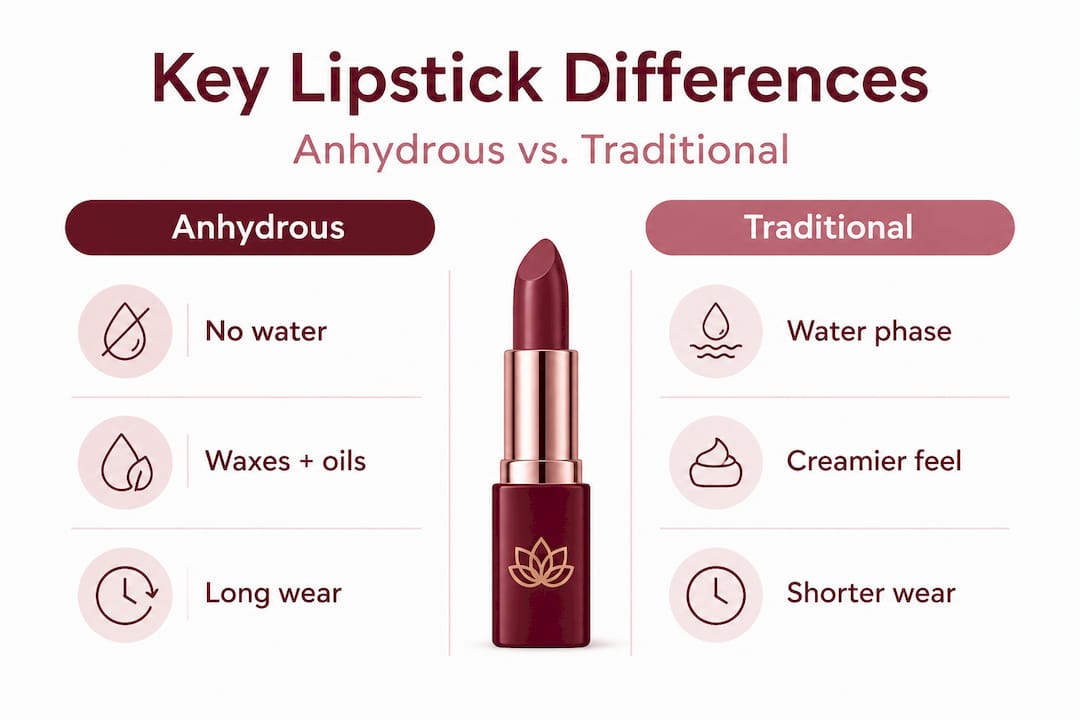
The wax-to-oil ratio impacts firmness, smoothness, and product stability in ways that directly affect how a lipstick performs across different climates, skin types, and wearing conditions. This is why two anhydrous lipsticks from different brands can feel completely different from each other, even though both are technically water-free.
One major point of confusion is the word “hydrating.” Many women assume that a lipstick labeled hydrating must contain water. In reality, excellent lip hydration can come entirely from the oil phase in an anhydrous formula. Emollient oils like castor oil or vitamin E create a conditioning effect without any water required. Our balm vs lipstick guide walks through how moisture delivery works across different product types.
The question of creamy lipstick hydration comes up often among women who are switching from traditional to anhydrous formulas. The short answer: a well-formulated anhydrous lipstick can feel just as comfortable and moisturizing as a creamy formula, sometimes more so, because the oils are not competing with a water phase for absorption.
Pro Tip: When you’re evaluating an anhydrous lipstick for the first time, apply a thin layer to the back of your hand and press your lips together. A quality formula should glide without dragging and leave a clean, defined edge of color. If it smears beyond where you applied it, the oil-to-wax ratio may be off.
Why anhydrous lipstick appeals to women 40+
For women over 40, lipstick performance requirements shift in very specific ways. Feathering, the tendency for lipstick to bleed into fine lines around the mouth, becomes a real concern. Fading is more noticeable. And the skin on the lips itself often becomes drier and thinner with age, demanding a formula that conditions rather than strips.
Anhydrous lipstick addresses each of these concerns in practical, measurable ways. Here’s why so many women 40+ are making the switch:
- Reduced feathering: The stable wax matrix creates a defined edge that holds its shape rather than migrating into lip lines.
- Stronger color payoff: Rich pigment dispersion means you achieve full color with a single application, rather than layering.
- Less reapplication: Longer wear time translates to fewer touchups throughout the day.
- Gentle on sensitive lips: The absence of water and most preservatives makes anhydrous formulas a lower-irritation option.
- No heavy fragrance required: Many anhydrous formulas use fewer masking agents because the base itself is more stable and less likely to smell “off.”
- Conditioned feel: Emollient oils deliver a soft, comfortable experience that supports the drier lip texture many women experience as they age.
Our lipstick for women 40+ resource explores these shifts in detail, but the core principle is this: mature skin benefits from formulas that do more with less. Fewer water-dependent ingredients, fewer preservatives, and a well-constructed lipid matrix all contribute to a product that respects the lip’s natural condition.
“Anhydrous formulations offer stability and improved pigment dispersion crucial for smooth application and mature lips.” This research finding confirms what experienced makeup artists have observed for years: when the formula is stable, the application is smoother, and the result is more flattering.
Women who explore non-drying lipstick tips often land on anhydrous formulas as the ideal balance between performance and comfort. The key is finding one where the oil selection is thoughtful, not just functional. Oils like marula, argan, and rosehip don’t just act as carriers; they actively condition the lip and contribute real skincare benefits with every wear.
Choosing a lipstick that aligns with a more evolved skincare approach is a shift that many women describe as a turning point. Once you start reading ingredient lists and understanding what makes a formula perform, it’s very hard to go back to choosing lipstick purely by shade.
Tips for selecting high-quality anhydrous lipstick
Armed with the right knowledge, shopping for an anhydrous lipstick becomes a far more confident experience. Here’s a numbered guide to help you evaluate options and make smarter choices:
- Read the ingredient list first. Look for waxes listed near the top (like carnauba, candelilla, or beeswax) and oils in the middle of the list. Their position tells you how dominant they are in the formula.
- Look for emollient-rich oils. Castor oil, jojoba, sweet almond, and vitamin E are all positive signs of a formula designed for comfort. Avoid products where synthetic fillers dominate the oil phase.
- Avoid unnecessary alcohols and astringents. These are more common in hydrous formulas but can occasionally appear in anhydrous ones. They dry out the lip surface and work against the emollient oils.
- Swatch on your lip, not your hand. The texture of your lips is unique, and a lipstick that feels smooth on your hand may feel different on your actual lip surface. Apply to the lower lip and press before fully blending.
- Check the bullet firmness. A high-quality anhydrous bullet should have a slight give under light pressure but not drag when applied. Excessive softness suggests too much oil; excessive firmness suggests too much wax.
- Assess the color payoff in natural light. Rich pigment dispersion, a hallmark of a well-made anhydrous formula, will show true to shade even in daylight. Formulas that look great in store lighting but dull outside often lack pigment density.
As formula research confirms, checking specific wax and oil components reveals how stable and smooth the formula will feel. This isn’t just technical trivia; it directly predicts your experience wearing the product.
Understanding emollients in lipstick can also help you decode which oils are doing the heavy lifting in any given formula and which are just along for the ride.
Pro Tip: If you travel frequently between climates or live in a region with dramatic temperature changes, like parts of Australia or Northern Europe, look for formulas that use harder waxes like carnauba near the top of the ingredient list. These offer better stability in heat without compromising the wear experience.
Here’s a quick reference table of common waxes and oils found in quality anhydrous formulas:
| Ingredient | Type | Typical benefit |
|---|---|---|
| Carnauba wax | Wax | High melting point, excellent firmness and gloss |
| Candelilla wax | Wax | Vegan, great structure and shine |
| Beeswax | Wax | Soft hold, natural conditioning |
| Castor oil | Oil | High viscosity, smooth slip and gloss |
| Jojoba oil | Oil | Lightweight, mimics skin’s natural sebum |
| Sweet almond oil | Oil | Rich, emollient, good for dry lips |
| Vitamin E (tocopherol) | Antioxidant/oil | Protects formula, conditions lips |
| Marula oil | Oil | Fast-absorbing, luxurious feel |
Each ingredient plays a specific role, and the combination determines the final character of the lipstick. A formula built on candelilla wax and castor oil will feel different from one built on beeswax and jojoba, even if the color is identical.
Why anhydrous lipstick is more than a trend
Here’s a perspective that the beauty industry rarely states out loud: the move toward anhydrous formulations is not a marketing trend. It’s a response to a genuine shift in how informed consumers think about what they put on their skin.
We’re seeing a broader movement toward formulas that do more with fewer ingredients. Women 40+ are leading that charge, not because they’re chasing trends, but because they’ve learned from experience. A formula that requires twenty-five ingredients, including preservatives, water, and stabilizers, to produce a basic result is not a more advanced product. It’s a more complicated one.
Anhydrous lipstick strips away that complexity. The lipstick application trends we’re tracking consistently show a movement toward longer wear, richer pigment, and formulas that feel kind to the skin. Anhydrous formulas hit all three of those marks when they’re done well.
The uncomfortable truth is that the conventional “creamy” lipstick, the kind that promises hydration through a water phase, often delivers less than it promises. The water evaporates. The humectants may draw moisture from the lip surface if the environment is dry. And the preservatives required to keep that water-phase safe over time are the very ingredients that can irritate sensitive skin.
Once you try a quality anhydrous formula and experience what genuine wax-oil stability feels like on the lip, the comparison is stark. The color is deeper, the wear is more consistent, and the comfort comes from a source (emollient oils) that actually conditions rather than simply masking dryness.
We believe the future of lip color is built on fewer but better ingredients, where each component earns its place in the formula. That’s not a trend. That’s progress.
Discover innovative anhydrous lipstick options
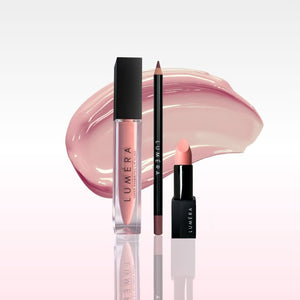
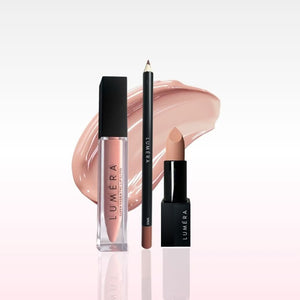
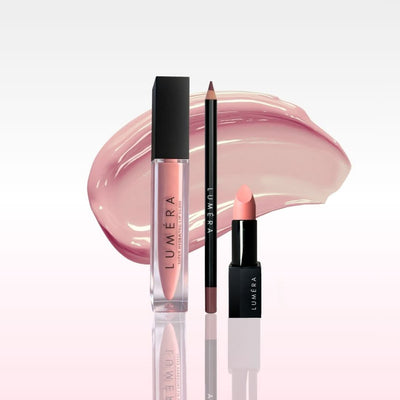
If this article has sparked genuine curiosity about what your lipstick formula is actually doing for you, that’s exactly where we want you to be. Luméra Cosmetica was built for women who want more than shade selection. Our formulas are designed with the wax-oil balance and pigment performance you’ve just read about, so you’re not guessing when you shop.
Visit the Luméra Cosmetica collection to explore our anhydrous lip color range, crafted specifically for women who expect both performance and comfort. Whether you’re looking for bold pigment, everyday wear, or a formula gentle enough for sensitive lips, we’ve built each product with the same standard: nothing that doesn’t earn its place in the formula. If you have questions or want guidance on finding your ideal match, our team is always available to help you navigate the options.
Frequently asked questions
Is anhydrous lipstick better for sensitive skin?
Yes, anhydrous lipstick’s stable, water-free formula is typically gentler and less likely to irritate sensitive lips, since it requires fewer preservatives and avoids the instability that a water phase can introduce.
How long does anhydrous lipstick last compared to regular lipstick?
Anhydrous lipstick usually lasts longer and resists fading because its wax-to-oil ratio creates a stable film on the lip that holds color without relying on a water phase that can evaporate.
Can anhydrous lipstick still feel moisturizing?
Absolutely. When formulated with quality emollient oils, anhydrous lipsticks deliver real comfort because the oil phase disperses pigments and maintains smooth slip across the lip surface throughout wear.
Is anhydrous lipstick harder or softer than creamy formulas?
Anhydrous lipstick tends to feel firmer, but the final texture depends heavily on the wax-oil balance, and a premium formula can deliver both definition and a silky, comfortable application that rivals the best creamy options.