

How to Choose Your Lipstick Color for Any Skin Tone

Match a lipstick’s undertone to your skin’s undertone, then pick the depth of color that suits your skin tone, from soft nudes on fair skin to rich berries on deep skin. Test any contender on your actual lips in natural daylight, not on your wrist under store lighting. Everything else, from finish to formula to occasion, is fine-tuning around that one rule.
TL;DR:
- Matching lipstick undertone to your skin’s undertone is crucial, with warm, cool, or neutral shades suited to your specific hue regardless of skin depth.
- Testing lip color directly on your lips in natural daylight provides the most accurate match, as store lighting or wrist swatches can be misleading.
- Matte finishes offer more saturated color but can emphasize texture, while gloss and satin finishes create a softer, more natural look.
- Deep and medium skin tones can handle saturated shades like berries and reds, while fair skin generally favors soft nudes and pinks, with undertone guiding the specific hue.
- For mature lips, prioritize hydrating formulas in warm shades that add brightness and avoid pale or frosted tones that settle into lines.
Table of Contents
- What’s the difference between skin tone and undertone?
- How do you determine your undertone at home?
- Which lipstick shades flatter fair, medium, and deep skin?
- Does lipstick finish change how a color looks?
- How should you swatch and test a lipstick before buying?
- What lipstick works best for mature lips over 40?
- Does lip shape matter when choosing a lipstick color?
- How do you match lipstick color to your outfit and the occasion?
- Should your natural lip color influence your lipstick pick?
- A quick word on rules versus personal taste
- Ready to try a shade that actually fits?
- Sources
What’s the difference between skin tone and undertone?
Skin tone is what you see: fair, medium, or deep, based on how much melanin is in your skin. Undertone is the subtler hue underneath that surface color, usually described as warm, cool, or neutral, and it doesn’t change with a tan or a pale winter. This distinction is exactly why a “perfect universal red” doesn’t exist. Two women with the same medium skin tone can need completely different reds if one leans warm and the other leans cool.
Undertone is what decides whether a shade looks like it belongs on your face or sits on top of it like a costume. A blue-based cherry red can look stunning on cool-undertone skin and slightly bruised on warm-undertone skin of the identical depth, according to Byrdie’s shade guidance.
A few things trip people up here:
- Sun exposure changes your tone (how dark or light you look) but rarely changes your undertone.
- You can have fair skin and a warm undertone, or deep skin and a cool undertone. Depth and undertone are independent variables.
- Neutral undertones exist too, and if that’s you, the rules loosen considerably.
Once you know both pieces, shade shopping stops being trial and error.
How do you determine your undertone at home?
You don’t need a professional color consultant to figure this out, though it’s an option if you want a deeper answer.
- Check the veins on your inner wrist. Blue or purple veins usually mean a cool undertone. Green veins point to warm. If you genuinely can’t tell, or you see a mix of blue-green, you’re likely neutral.
- Try on gold and silver jewelry. If gold makes your skin glow and silver looks slightly flat against it, you’re probably warm. If silver looks brighter and gold looks muddy, you’re likely cool.
- Think about how you react to sun. Burning easily and rarely tanning tends to correlate with cool undertones. Tanning easily with minimal burning tends to correlate with warm. Both, again, points to neutral.
These three checks, drawn from the same reasoning Byrdie uses to map undertone to shade, usually agree with each other. When they don’t, don’t overthink it. Skip straight to swatching lipstick directly on your lips, since that’s the most reliable signal anyway.
Pro Tip: If your vein test says cool but your jewelry test says warm, try a rosy mauve first. It’s the safest neutral bridge shade while you figure out where you actually land.
Which lipstick shades flatter fair, medium, and deep skin?
This is where undertone and skin tone work together, not separately. Depth of skin tells you roughly how saturated a shade can go before it overwhelms you. Undertone tells you whether that shade should lean warm, cool, or split the difference.
Fair skin. If you’re cool-toned, blue-based reds, soft baby pinks, and rosy mauves tend to look the most natural. If you’re warm-toned, reach for peachy nudes and soft coral instead of anything blue-based, which can look harsh against lighter, warmer skin. According to Byrdie, fair skin generally suits soft nudes and light pinks as a starting point, then you adjust the undertone from there.
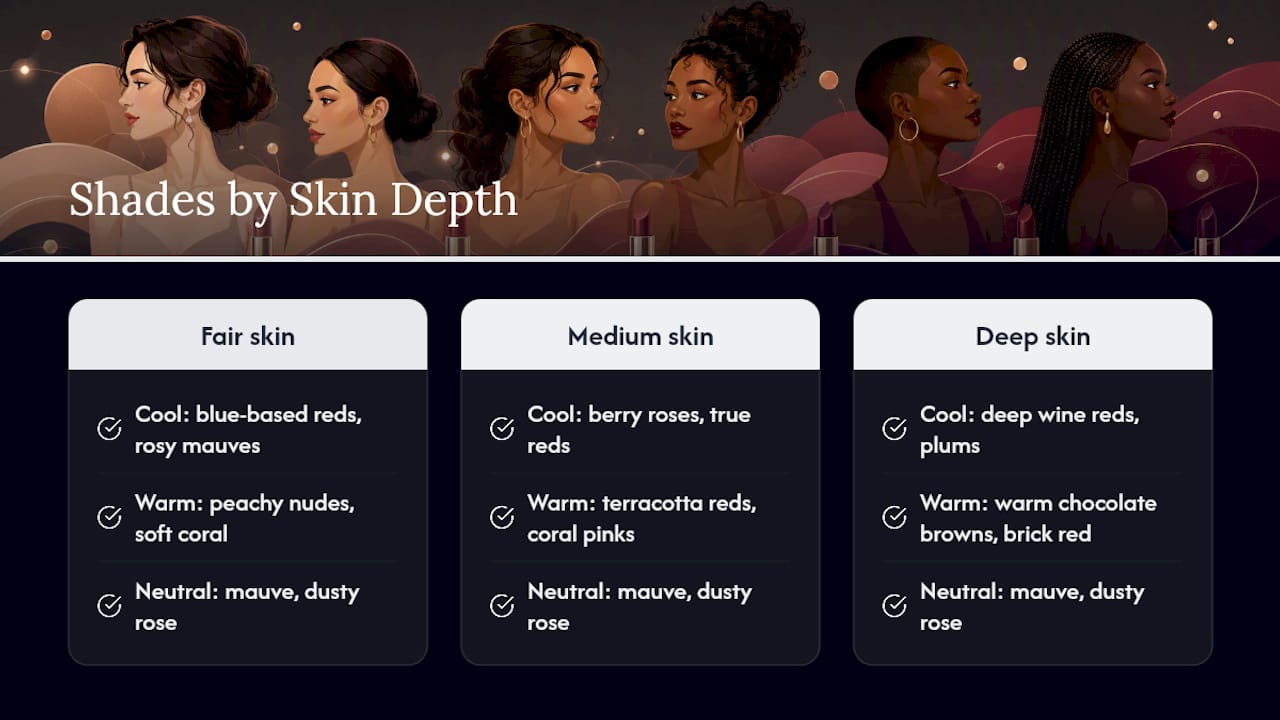
Medium skin. This is arguably the widest playground. Roses, warm corals, and buildable berries all read beautifully, and medium skin can usually handle more saturated color than fair skin without looking overdone. Warm undertones do best in terracotta reds and coral pinks. Cool undertones look better in berry roses and true reds without an orange base.
Deep skin. Rich pigment reads as rich, not garish, on deeper skin, which is why plums, deep wine reds, and warm chocolate browns tend to look luminous rather than flat. Byrdie’s tone mapping points to exactly this: deep skin complements rich berries, deep reds, and plums particularly well. If you want something brighter for daytime, a brick red or a saturated coral can pop against deep skin in a way it simply won’t on lighter tones.
Neutral undertones. If your at-home tests came back split, you’re in the easiest category, not the hardest. InStyle’s makeup-artist sourcing confirms that neutral undertones are the most versatile of the three, and shades like mauve, dusty rose, and balanced nude reds tend to work regardless of the exact skin depth underneath them.
Does lipstick finish change how a color looks?
Yes, dramatically, and this is the variable most people ignore entirely. The exact same pigment in matte versus gloss can look like two different colors on your lips.
- Matte delivers the strongest, most saturated color payoff, but it also clings to texture and can highlight dry patches or fine lines.
- Satin and cream finishes soften the color slightly and add visible hydration, which tends to read as more polished on most skin.
- Gloss brightens and reflects light, making a shade look juicier and a shade or two lighter than the tube suggests.
- Stains last the longest through eating and talking, but many dry out the lips over time, so pair them with a balm underneath.
For mature lips specifically, moisturizing satin or cream formulas generally outperform mattes, since matte finishes can settle unevenly into lip lines and emphasize texture rather than smooth it, per Cosmopolitan’s skin-tone shade guide. If you want maximum color intensity for a night out, go opaque. If you want a softer, more natural everyday look, a sheer or buildable formula gives you control over how much pigment shows.
How should you swatch and test a lipstick before buying?
Never trust a wrist swatch, and never trust a color you’ve only seen under fluorescent store lighting. The lips have their own tone and texture, and indoor lighting shifts color more than most people realize.
- Swatch directly on your lips, ideally over a bit of balm so you see how the formula behaves on lip texture rather than dry skin.
- Step outside or toward a window and look at it in natural daylight. This single step catches more mismatches than any other test, since Cosmopolitan notes swatching on the lips and checking in daylight is the most reliable method available.
- Walk back indoors and watch how the shade shifts under warm bulbs versus cool overhead lighting, especially if you’ll be wearing it somewhere with unpredictable lighting, like an evening event.
- If a shade reads slightly too dark or too bold, soften it with a layer of clear gloss on top rather than abandoning it entirely.
Virtual try-on tools are genuinely useful for narrowing a huge selection down to a handful of realistic contenders, but Perfect Corp’s own guidance acknowledges that screen calibration and camera quality can shift how a color renders, so treat it as a first pass, never the final word.
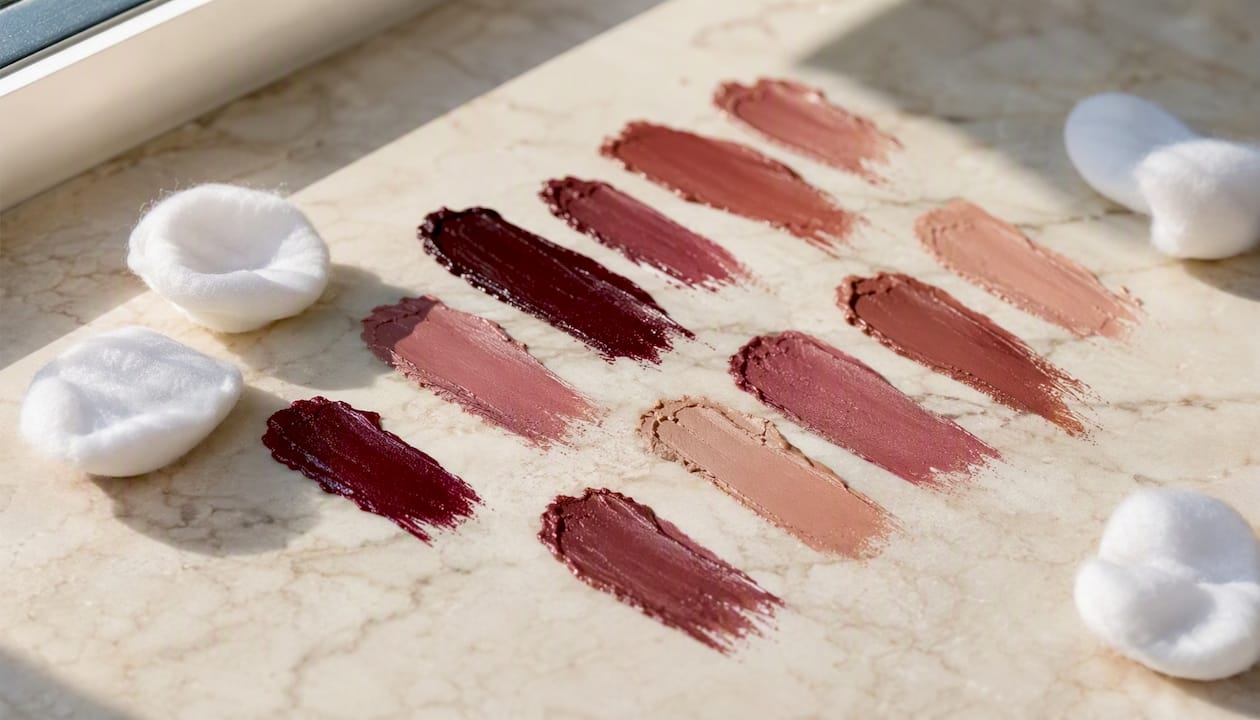
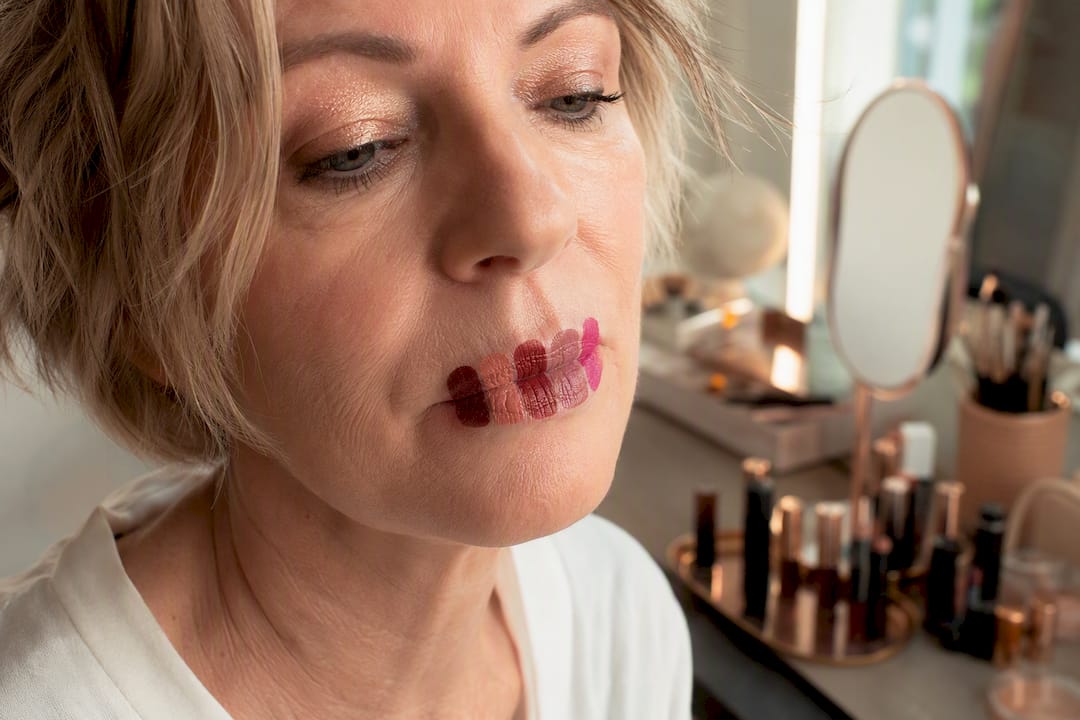
Pro Tip: Try the five-swatch method. Pick a nude, a soft pink, a bold red, a berry, and a coral or coral-red, then swatch all five on your lips at once and compare them in daylight side by side. Seeing the contrast makes the right choice obvious almost instantly.
What lipstick works best for mature lips over 40?
Skip frosted and overly pale chalky shades. Both tend to settle into fine lines and can wash out facial brightness rather than enhance it, a pattern Cosmopolitan flags specifically for mature skin. What works instead is pigment with warmth: think warm corals, soft dusty roses, and richer berries rather than beige-adjacent “safe” nudes that can flatten your whole complexion.
- Use a lip liner slightly close to your natural lip line to add structure and prevent color from feathering into lines.
- Layer a conditioning balm underneath color, then reapply a thin second coat rather than one thick layer.
- Choose satin or cream finishes over matte for the reasons covered above; hydration reads as youthful, dryness does not.
- Exfoliate lips gently once or twice a week and keep a hydrating treatment in rotation between full color days.
For a deeper walkthrough on shade selection specifically tuned to this age group, Lumeracosmetica’s guide to lip colors that enhance your look over 40 breaks down exactly which pigments restore brightness without looking harsh.
Pro Tip: If a shade looks great in the tube but slightly stark on application, warm it up by dabbing a touch of gloss or balm over the center of your lips only. It softens the edges and looks far more natural than blotting the whole thing.
Does lip shape matter when choosing a lipstick color?
Shape affects application technique more than it restricts color choice, but it’s still worth factoring in. Thinner lips generally look fuller with lighter, brighter shades and a touch of gloss, since darker or matte colors can make lips appear smaller by adding visual weight and shrinking the perceived surface area. Fuller lips can carry darker, more matte pigments without looking overwhelmed, because there’s more surface area for the color to sit on.
If your lips are asymmetrical, and most people’s are to some degree, a lip liner does more work than the lipstick color itself. Line slightly outside your natural border on the thinner side and closer to true on the fuller side to even things out before you add color. Downturned corners benefit from warmer, brighter shades applied with a slight upward blend at the edges, which lifts the overall look.
Size and shape don’t change which undertone flatters you, that’s still governed by your skin. What changes is how you apply the shade you’ve already chosen. A bold berry works on both a fuller lip and a thinner one; it just needs slightly different liner work and blending technique to look intentional rather than uneven.
How do you match lipstick color to your outfit and the occasion?
Outfit color and event formality both narrow the field once undertone and skin tone have already done the heavy lifting. A cool-toned blue-red looks sharp against jewel tones and black, while a warm coral or peachy nude tends to sit better with earth tones, denim, and warm neutrals.
For everyday wear, whether that’s work, errands, or school pickup, a satin nude or rosy shade close to your natural lip color is the lowest-effort, highest-payoff choice. It requires almost no touch-ups and pairs with anything. For evening events, a bolder, more saturated pick, a true red, a deep berry, a rich plum, signals occasion without needing much else in the way of dramatic eye makeup.
One useful shortcut comes from seasonal color analysis, a system that assigns each person a small set of “signature” shades based on their overall coloring rather than outfit-by-outfit matching. House of Colour’s approach typically recommends three go-to lipstick shades per person, often a red, a coral, and a pink variant tailored to that individual’s palette, which simplifies outfit coordination since those three shades are chosen to already work with everything else in a matching color story.
Should your natural lip color influence your lipstick pick?
Yes, more than most shopping guides admit. Your natural lip pigmentation acts as a base layer under whatever color you apply, and it shifts the final result more than the shade name on the tube suggests. Deeper natural lip pigmentation, common on many medium and deep skin tones, can shift a sheer pink toward mauve or make a bright coral read slightly more muted than it appears in the packaging.
If your natural lip color is notably darker than the rest of your face, a clear or neutral lip primer evens the base first, so the color you’re applying reads true rather than mixing unpredictably with your own pigment. If you want a lipstick to look exactly like the bullet, opaque, fully pigmented formulas cover natural lip tone more completely than sheers or tints, which are designed to blend with what’s already there rather than override it.
This is also why the same product can look completely different on two people with matching skin tones. Undertone and skin depth get you close, but natural lip pigmentation is the last variable, and it’s the one swatching on your actual lips catches that no shade chart ever will.
A quick word on rules versus personal taste
Everything above narrows your options. None of it decides for you. Makeup artists lean on undertone and skin tone logic because it saves time, not because a “wrong” shade exists for a given face. I’d argue the biggest mistake people make is treating a color chart as gospel instead of a shortlist.
Run the five-swatch method, trust what you see in daylight over what a chart says you should like, and let personal preference break any tie. If you want a curated starting point instead of building one from scratch, Lumeracosmetica’s lipstick guide for mature skin is a solid next stop.
— Rebecca
Ready to try a shade that actually fits?
Lumeracosmetica builds every formula around the same logic covered here: match undertone first, then pick depth by skin tone, and never sacrifice hydration for pigment. That’s the difference between a lipstick that photographs well in a tube and one that still looks good three hours into your day.
If mature, textured lips are your main concern, the Perfect Kiss Lipstick is built specifically around rich, smooth, all-day wear without the settling-into-lines problem that plagues typical mattes. Want to add dimension on top of any shade you already own? The Ombre Effect Lip Hi-Lighter layers over color to brighten the center of the lip, a trick that works especially well on fuller or asymmetrical lip shapes.
Swatch first, always, but if you’d rather skip the guesswork of building a shade wardrobe piece by piece, start with a curated kit matched to your undertone and go from there.
Sources
Byrdie breaks down undertone versus skin tone with practical shade picks. InStyle offers makeup-artist guidance on undertone testing. Cosmopolitan maps shade families to skin depth. House of Colour explains seasonal palette analysis.
- How to Choose a Lipstick Shade Based on Your Skin Tone — Byrdie
- What Color Lipstick Should I Wear? Try These Makeup Artist Picks — InStyle
- The Best Lipstick Colors for Every Skin Tone — Cosmopolitan
- How Colour Analysis Helps You Choose the Perfect Lipstick — House of Colour


