

Is e.l.f. Cosmetics Really Vegan? A Verification Guide

e.l.f. Cosmetics says all of its makeup and skincare is 100% vegan and cruelty-free, meaning no animal ingredients and no animal testing at any stage. That claim checks out against independent registries, which matters more than a brand’s own marketing copy ever should.
PETA’s Beauty Without Bunnies program lists e.l.f. as cruelty-free, a third-party confirmation that carries real weight because PETA requires companies to sign a statement of assurance covering their supply chain, not just their own labs.
That said, “cruelty-free” and “vegan” are not the same promise, and a smart shopper checks both before trusting a label at face value.
- e.l.f.'s brand policy pages state the claim covers makeup, skincare, and tools.
- PETA’s listing confirms no animal testing, but it does not itself confirm every ingredient is animal-free.
- Individual product ingredient lists are still the final word on any specific item.
Skip to the quick checklist below if you want the fast version. Otherwise, here’s how to actually verify any of it yourself.
Key Takeaways
e.l.f.'s vegan and cruelty-free claim holds up under independent scrutiny, but confirming a specific product still requires checking its ingredient list and any relevant registry yourself.
| Point | Details |
|---|---|
| Brand claim is verified | PETA’s cruelty-free listing backs e.l.f.'s brand-wide no-animal-testing policy. |
| Vegan and cruelty-free differ | Cruelty-free means no animal testing; vegan means no animal-derived ingredients at all. |
| Check the INCI list | Watch for carmine, beeswax, lanolin, and unspecified glycerin on specific products. |
| Brushes are the easy case | e.l.f. brushes use synthetic bristles like taklon, with no natural animal hair involved. |
| Lumeracosmetica curates vetted picks | Lumeracosmetica’s guides help shoppers cross-check vegan claims before buying. |
Table of Contents
- What e.l.f. Says About Its Vegan and Cruelty-Free Status
- How to Verify e.l.f.'s Claims Through Independent Registries
- Reading the Label: How to Confirm a Specific Product Is Vegan
- Are e.l.f. Makeup Brushes Vegan and Cruelty-Free?
- An Editorial Take on Verifying Beauty Brand Claims
- Quick Checklist: What to Do Before You Buy a “Vegan” e.l.f. Product
- How e.l.f. Handles Suppliers and Third-Party Testing
- Vegan vs. Cruelty-Free: Why e.l.f. Products Need Both Checks
- Exceptions and Controversies Around e.l.f.'s Vegan Claims
- e.l.f.'s Sustainability Efforts Beyond the Vegan Claim
- Shopping Vegan Without Overspending
- Where to Find Curated Vegan Picks Without the Guesswork
- Sources
- FAQ
What e.l.f. Says About Its Vegan and Cruelty-Free Status
e.l.f.'s own policy language is direct: the company states its makeup and skincare products contain no animal ingredients and have never been tested on animals, at any point in development or on the finished product. That phrasing is broader than some competitors offer, since some brands only pledge no finished-product testing while staying vague about ingredient-level testing done by suppliers.
The brand extends the same language to its brushes and tools, describing them as synthetic and animal-free, not just the pigments and formulas that go on your skin.
A few things worth noting about how the policy is framed:
- The claim applies brand-wide, not to a single “clean” sub-line or capsule collection.
- e.l.f. frames this as a global policy rather than a claim scoped to one country’s regulatory standard.
- The language covers both “vegan” (no animal-derived ingredients) and “cruelty-free” (no animal testing) as a combined promise, which is unusual since most brands separate the two claims.
That combined framing is convenient for shoppers, but it’s still worth understanding how each half gets verified independently.
How to Verify e.l.f.'s Claims Through Independent Registries
A brand’s own website is a starting point, not proof. Independent registries exist specifically because self-reported claims can’t be taken purely on faith, and two organizations dominate this space for a reason.
- PETA’s Beauty Without Bunnies list requires signed assurance that a company and its suppliers don’t commission or pay for animal testing anywhere in the supply chain. e.l.f. appears on this list, which is a meaningful signal since PETA’s criteria extend beyond the brand’s own labs to its suppliers.
- Leaping Bunny certification works differently. It’s an audited program run by Cruelty Free International, and it certifies at the product line level after a formal review, not as a blanket brand statement. Some brands carry Leaping Bunny certification alongside a PETA listing; others rely on PETA alone.
- To check either registry yourself, search the company name directly on PETA’s cruelty-free database or the Leaping Bunny compliant-company list rather than trusting a badge printed on packaging, which can be outdated or unverified.
Pro Tip: A missing Leaping Bunny badge doesn’t mean a brand fails the standard. It often just means the brand hasn’t pursued that specific certification. PETA’s listing and Leaping Bunny certification are separate systems, so check both by name instead of assuming one implies the other.
Reading the Label: How to Confirm a Specific Product Is Vegan
Cruelty-free tells you about testing. Vegan tells you about what’s actually in the formula, and that requires reading the ingredient list yourself. Cosmetic ingredients are listed using INCI names, the standardized international naming system, which is why “sodium tallowate” or “cera alba” won’t obviously read as animal-derived unless you know what to look for.
Common animal-derived ingredients that occasionally show up in cosmetics include:
- Carmine (crushed cochineal insects, used for red pigment)
- Beeswax (cera alba)
- Lanolin (from sheep’s wool)
- Collagen and keratin (often animal-sourced unless specified as plant-derived or synthetic)
- Tallow derivatives (rendered animal fat)
- Some glycerin (can be plant, synthetic, or animal-sourced depending on the manufacturer)
You’ll find full ingredient lists on e.l.f.'s individual product pages, usually below the description and reviews. If a listed ingredient’s origin isn’t clear, contact customer service directly and ask a specific question: “Is the glycerin in [product name] plant-derived or animal-derived?” Save the reply, since a screenshot or email thread gives you something concrete if the same question comes up again later.
Are e.l.f. Makeup Brushes Vegan and Cruelty-Free?
Yes. e.l.f.'s brush and tool pages state the bristles are synthetic, not natural animal hair, which is the main historical concern with brushes (squirrel, sable, and goat hair have all been standard in traditional brush manufacturing).
Brushes are actually the easier product category to verify, since there’s no complex chemical formula to parse:
- Look for “synthetic,” “nylon,” or “taklon” in the product description. Taklon is a common synthetic fiber used specifically to mimic natural bristle softness.
- Check that the handle and ferrule (the metal band holding bristles in place) aren’t described as using animal-based glues, though this is rarely an issue with major brands.
- Trust the product-page statement over a generic “cruelty-free” sticker on the packaging, since the page language is more specific to that exact tool.
An Editorial Take on Verifying Beauty Brand Claims
The gap between a brand’s policy page and an individual product’s actual ingredient list is where most vegan-shopping mistakes happen. A company can be entirely sincere about its brand-wide policy while a single shade or limited-edition formula slips in an ingredient sourced from a supplier who hasn’t fully documented its own supply chain. That’s not deception. It’s just the reality of manufacturing at scale across dozens of suppliers.
The gray areas worth knowing about: supplier-level testing that a brand doesn’t directly control, ambiguous derivatives like glycerin or stearic acid that can come from plant or animal sources depending on the batch, and regional regulatory requirements that occasionally still mandate animal testing for specific ingredient categories in certain markets.
When you contact customer support, a reply that names the specific ingredient’s source (“our glycerin is vegetable-derived”) is worth trusting. A generic “yes, this product is vegan” copy-paste response is not, since it tells you nothing about how that answer was determined.
Pro Tip: If a brand has a public, PETA-verified policy and a specific product’s ingredient list shows nothing on your watch-list, that’s a reasonable threshold to buy. Save the deep-dive skepticism for products with vague or unlisted ingredients.
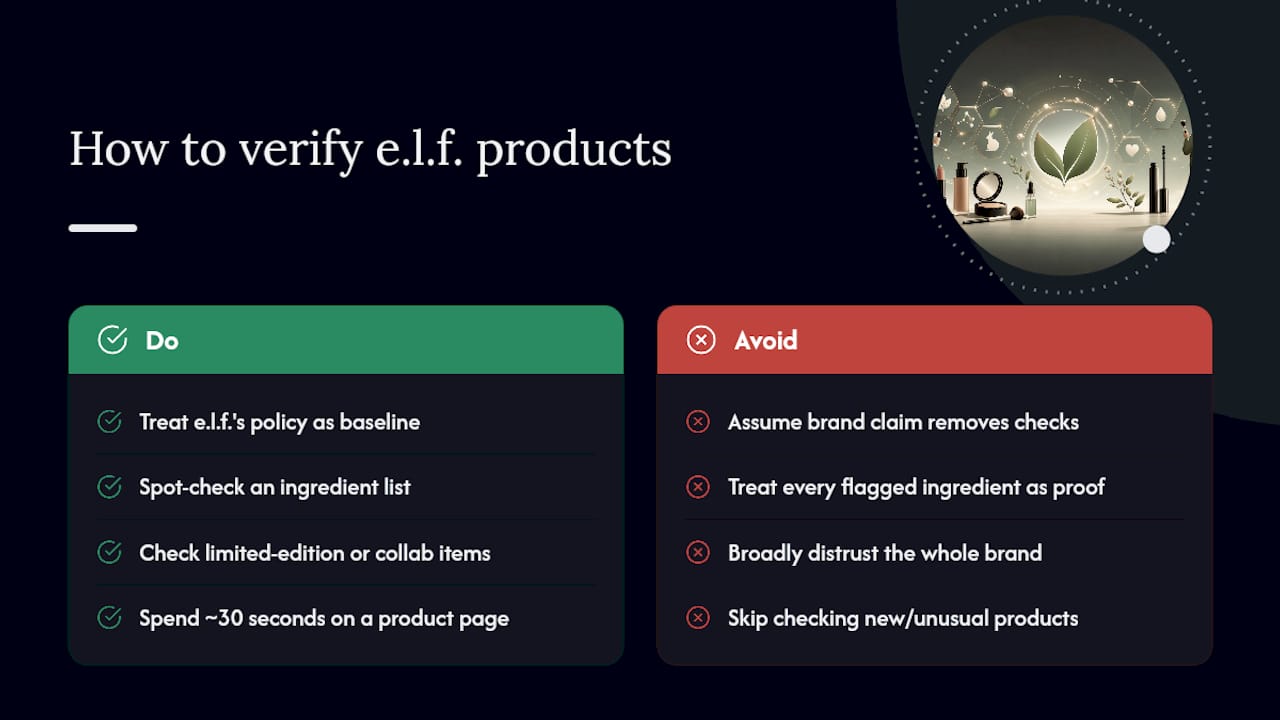
Quick Checklist: What to Do Before You Buy a “Vegan” e.l.f. Product
Run through this before you check out, whether you’re shopping online or standing in a store aisle:
- Look for the badge. Check the product page or packaging for a vegan or cruelty-free label.
- Read the INCI list. Scan for carmine, beeswax, lanolin, collagen, keratin, or unspecified glycerin.
- Check the registries. Search PETA’s cruelty-free database and the Leaping Bunny compliant list by brand name.
- Ask directly if unsure. Message customer service: “Can you confirm the [ingredient] in [product] is plant-derived?”
- Document the answer. Screenshot or save the reply for future reference.
Skip the product entirely if an ingredient is listed as “may contain animal-derived [X]” with no clarification available, or if customer support can’t answer a direct sourcing question after being asked twice.
How e.l.f. Handles Suppliers and Third-Party Testing
A brand’s vegan and cruelty-free promise is only as strong as its weakest supplier, since most cosmetics companies don’t manufacture every raw ingredient themselves. e.l.f. sources pigments, waxes, and specialty ingredients from a network of third-party suppliers, and the brand’s public statement extends its no-animal-testing pledge to that entire chain, not just its own facilities.

This is actually the harder part of any cruelty-free claim to verify independently, since a shopper has no direct way to audit a supplier’s internal lab practices. That’s exactly why PETA’s assurance program matters here: signing onto the Beauty Without Bunnies list requires a company to affirm, in writing, that neither it nor its suppliers conduct or commission animal testing. It’s a documented commitment rather than a marketing tagline, even if it still relies on the brand’s own reporting rather than an independent factory audit.
Some regulatory markets still require animal testing for certain ingredient categories, which creates a genuine complication for any brand selling internationally. A company can hold a sincere, brand-wide cruelty-free policy while a specific formula sold in a market with different rules faces a different testing requirement, entirely outside the brand’s control. e.l.f. frames its policy in global terms, but shoppers buying in regions with stricter animal-testing mandates for specific ingredient classes may want to check whether any regional exceptions apply before assuming universal coverage.
Vegan vs. Cruelty-Free: Why e.l.f. Products Need Both Checks
These two terms get used interchangeably in casual conversation, but they answer completely different questions, and treating them as synonyms is where most shoppers get tripped up.
Cruelty-free is about process. It means the product, its ingredients, and its formulation weren’t tested on animals at any stage. A cruelty-free product can still contain animal-derived ingredients like honey, beeswax, or carmine, none of which require animal testing to produce but all of which come from animals.
Vegan is about content. It means the product contains zero animal-derived ingredients or byproducts, regardless of whether animal testing was involved anywhere in the process.
e.l.f.'s policy claims both at once, which is genuinely useful since it means you don’t have to run two separate checks for most products. But the distinction still matters for how you read the ingredient list. A product can pass the cruelty-free test with flying colors and still fail the vegan test if it contains lanolin or beeswax. That’s why the ingredient-reading process covered earlier is a separate step from checking PETA’s registry, not a redundant one. One confirms testing practices; the other confirms formula content. e.l.f.'s brand-wide claim bundles both, but a careful shopper still verifies them as the two distinct questions they actually are.
Exceptions and Controversies Around e.l.f.'s Vegan Claims
e.l.f.'s brand-wide vegan and cruelty-free policy has held up well against independent scrutiny, and the brand doesn’t carry the kind of documented reversal or scandal that has hit other cosmetics companies over the years. That’s worth stating plainly, since not every brand making similar claims has this track record.
Where some ambiguity does exist: independent product-checker communities and beauty blogs occasionally flag specific formulations with ingredients that read as ambiguous on a label, things like unspecified glycerin or certain fatty acid derivatives that could theoretically be sourced from either plants or animals depending on the manufacturer’s supply chain that particular season. None of this amounts to a documented violation of e.l.f.'s stated policy, but it’s a reasonable reminder that a brand-wide claim doesn’t eliminate the value of checking an individual product’s ingredient list, particularly for limited-edition or collaboration items that sometimes use different suppliers than the core line.
The practical takeaway isn’t suspicion. It’s habit. Treat e.l.f.'s policy as a strong baseline you can generally trust, backed by its PETA listing, while still spot-checking new or unusual products the way you would with any brand, vegan-focused or not. That habit costs you thirty seconds on a product page and saves you from an occasional surprise.
e.l.f.'s Sustainability Efforts Beyond the Vegan Claim
Vegan and cruelty-free status covers ingredients and testing, but it doesn’t tell you anything about packaging waste, sourcing ethics for non-animal materials, or a brand’s broader environmental footprint, categories where e.l.f. has made separate, distinct commitments.
The brand has publicly emphasized clean formulation standards, avoiding certain chemical categories like parabens and phthalates across its core lines, which is a formulation choice separate from the vegan question but often bundled together in how ethically-minded shoppers evaluate a brand overall. e.l.f. has also talked about packaging initiatives aimed at reducing plastic use and increasing recyclability, though the specifics vary by product line and region.
For shoppers who care about the full ethical picture, not just the animal-welfare angle, it’s worth treating “vegan,” “cruelty-free,” “clean,” and “sustainable” as four separate claims that happen to overlap in marketing copy but don’t automatically imply one another. A vegan product isn’t necessarily packaged sustainably. A cruelty-free brand isn’t necessarily using recycled plastic. e.l.f. addresses several of these categories, but each deserves its own quick check if it’s a priority for you, the same way you’d separately verify vegan status and cruelty-free status rather than assuming one confirms the other.
Shopping Vegan Without Overspending
Verifying a claim shouldn’t feel like a research project every time you shop. I’ve found the fastest habit is checking a product’s ingredient page once, saving the answer, and trusting the pattern for that line going forward. For a deeper walkthrough of e.l.f.'s specific policies, Lumeracosmetica’s cruelty-free breakdown is worth a slower read.
Where to Find Curated Vegan Picks Without the Guesswork
Verifying a single product’s ingredients is manageable. Doing it across an entire makeup bag, shade by shade, brand by brand, is where most ethical shoppers lose patience. That’s the gap Lumeracosmetica fills: curated, pre-checked vegan cosmetic recommendations, so you’re not re-running the same PETA search and INCI scan for every new product that catches your eye.
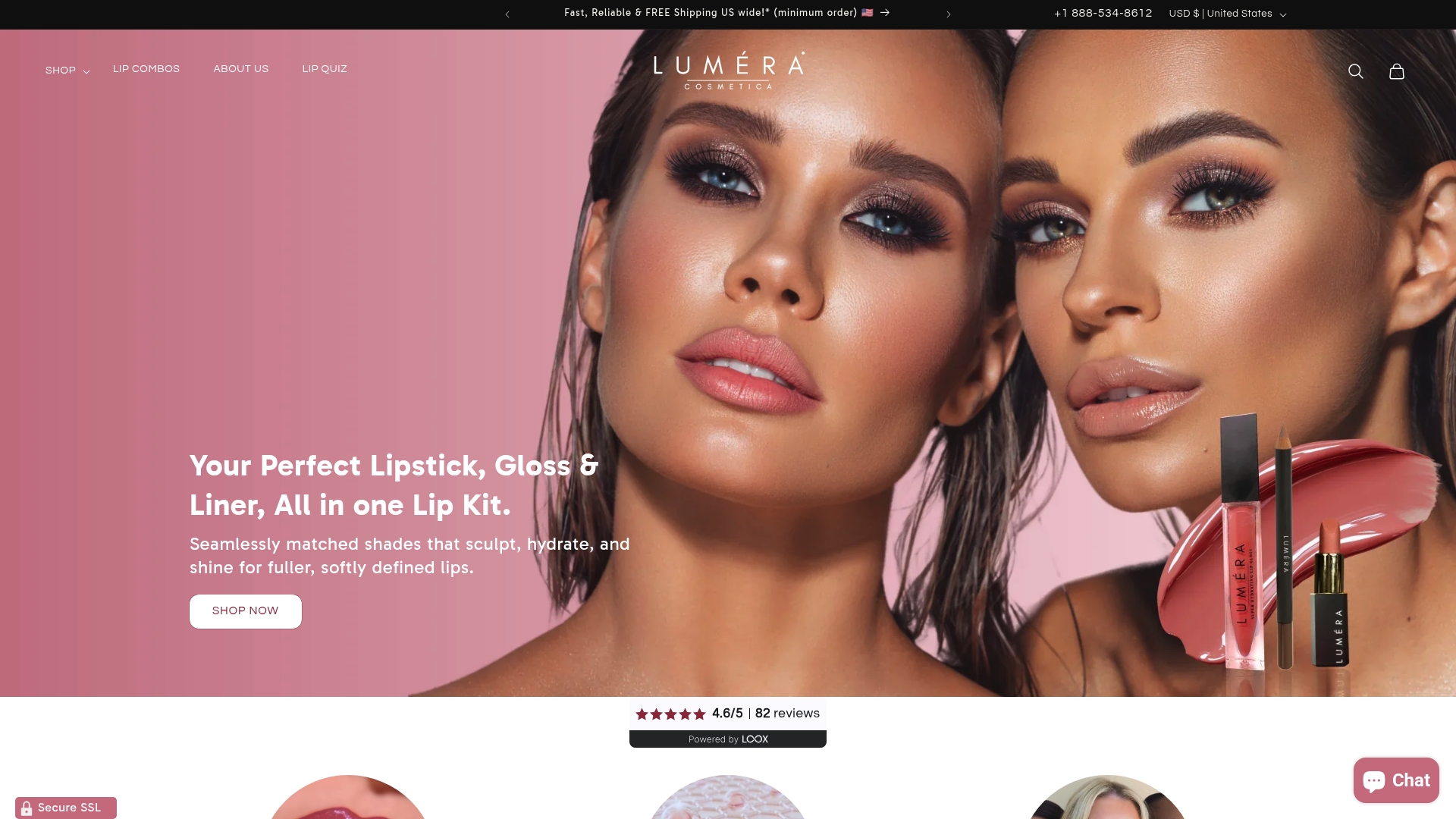
If you’d rather compare formulations and pricing across brands before committing, a marketplace like Mega Pallets Liquidation offers bulk options worth a look for budget-conscious shoppers. For a more curated, editorially-vetted path, visit Lumeracosmetica to browse lipstick and beauty picks that have already been checked against the standards covered here.
Sources
FAQ
Is e.l.f. Cosmetics fully vegan? e.l.f. states its makeup and skincare products contain no animal ingredients, and this claim applies brand-wide rather than to a single product line.
Is e.l.f. cruelty-free according to PETA? Yes. PETA’s Beauty Without Bunnies program lists e.l.f. as cruelty-free, which requires the brand and its suppliers to sign an assurance against animal testing.
Does e.l.f. have Leaping Bunny certification? Leaping Bunny certifies brands through a separate, audited process from PETA’s listing. Check the Leaping Bunny compliant-company database directly by brand name to confirm current status, since certification can change over time.
Are e.l.f. makeup brushes vegan? Yes. e.l.f.'s brush product pages describe bristles as synthetic materials like taklon rather than natural animal hair.
What ingredients should I watch for if I want a strictly vegan product? Carmine, beeswax, lanolin, collagen, keratin, tallow derivatives, and unspecified glycerin are the most common animal-derived ingredients that occasionally appear in cosmetic formulas.
What’s the difference between vegan and cruelty-free? Cruelty-free refers to testing practices; vegan refers to ingredient content. A product can be cruelty-free without being vegan if it contains ingredients like honey or beeswax.


