

Matte vs. Satin Lipstick: What Actually Sets Them Apart

Matte lipstick trades comfort for staying power. Satin trades staying power for comfort. That’s the whole decision tree, and once you accept it, choosing gets a lot easier.
If you need color that survives a 10-hour shift, a wedding, or a camera lens, matte wins. It resists transfer and typically holds for 6 to 8 hours. If your lips are dry, you’re wearing color for a casual day, or you just want something that feels good on your mouth, satin is the better call, though it usually needs a touch-up within 3 to 5 hours. Beauty editors increasingly frame satin as the finish for everyday comfort, while matte still owns the “long wear, bold color” lane, according to The Healthy Curve.
- Long meetings, humid weather, photos: matte
- Dry lips, sensitive skin, all-day comfort: satin
- Bold, flat color with no shine: matte
- Soft, natural sheen with a hydrated look: satin
Lumeracosmetica builds formulas around exactly this trade-off, which is worth understanding before you buy either type.
Key Takeaways
Matte lipstick lasts longer and resists transfer better, while satin lipstick stays more comfortable and flatters textured or aging lips.
| Point | Details |
|---|---|
| Chemistry drives behavior | Matte relies on powders and silicones; satin relies on emollients like dimethicone and castor oil. |
| Wear time differs sharply | Matte typically lasts 6 to 8 hours; satin typically lasts 3 to 5 hours before a touch-up. |
| Texture appearance changes by finish | Satin reflects light to soften fine lines; matte absorbs light and can highlight them. |
| Match finish to the day | Rotate between matte for long events or photos and satin for comfort and dry lips. |
| Lumeracosmetica covers both needs | Its Ombre Effect Lip Hi-Lighter offers a buildable, light-reflecting satin finish for daily wear. |
Table of Contents
- What Is the Difference Between Matte and Satin Lipstick, Chemically?
- What Is Satin Lipstick and How Does It Differ From Cream or Gloss?
- Matte vs. Satin Lipstick: A Side-by-Side Comparison
- How Long Does Matte or Satin Lipstick Actually Last?
- Does Lipstick Finish Change How Fine Lines and Lip Texture Look?
- How to Apply Matte and Satin Lipstick Without Cracking or Feathering
- Matching Lipstick Finish to Your Day, Climate, and Lip Condition
- Matte vs. Satin: Weighing the Trade-Offs
- Lumeracosmetica’s Guidance for Choosing a Daily Finish
- The Real Mistake People Make Choosing Between Finishes
- Find Your Next Finish With Lumeracosmetica
- Sources
What Is the Difference Between Matte and Satin Lipstick, Chemically?
Matte lipstick is built to disappear the shine and stay put. It dries down flat, delivers dense pigment in a single swipe, and resists smudging because the formula is engineered to do less moving around on your lips.
The ingredient list explains the behavior. Matte formulas typically lean on volatile silicones that evaporate after application, along with powders like kaolin clay or silica that soak up excess oil and leave a dry, velvety film. Less oil in the formula means less slip, and less slip means the color stays exactly where you put it instead of migrating into fine lines or onto your coffee cup. That’s also why matte reads so well on camera: flat surfaces don’t catch flash the way a shiny one does, so the color looks saturated and true instead of washed out by glare.
There’s a real cost to that trade-off. Surveys referenced by beauty editors point to lip dryness as one of the top complaints people have about their everyday lip health, and matte formulas can make that worse if your lip barrier is already compromised, according to Lipstick Queen.
- Flat, no-shine finish with maximum color payoff
- Volatile silicones and mattifying powders create the dry, set-in-place texture
- Best photographic performance because there’s no shine to bounce light
- Higher risk of emphasizing dryness or flaking on compromised lips
What Is Satin Lipstick and How Does It Differ From Cream or Gloss?
Satin lipstick sits in the middle. It’s not flat like matte and not wet-looking like gloss. It’s a soft, low-key sheen that still reads as polished color rather than shine.
That middle ground comes from emollients. Ingredients like dimethicone, castor oil, lanolin, and vitamin E keep the formula’s film flexible instead of letting it dry into a hard, matte layer. Those oils and conditioning agents also feed some moisture back into your lips while you wear the color, which is why satin formulas tend to feel noticeably more comfortable over several hours. Editorial coverage describes satin as the “missing link” between matte and gloss, more reflective than a flat finish but nowhere near as slick as a lip gloss, according to VUE magazine.
Opacity works differently, too. Matte typically delivers full pigment in one pass. Satin is often more buildable, meaning a single layer gives you a sheer, natural wash of color while a second pass deepens it, which makes it more forgiving if you’re layering shades or trying to match an exact tone. The sheen itself does something practical for texture: because it reflects light rather than absorbing it, it softens the look of lip lines instead of highlighting them.
- Soft sheen, not flat and not glossy
- Dimethicone, castor oil, lanolin, and vitamin E keep the formula flexible and moisturizing
- Buildable pigment, from sheer to medium coverage
- Reflective finish that visually smooths texture
Matte vs. Satin Lipstick: A Side-by-Side Comparison
Here’s how the two finishes stack up across the factors that actually affect your day.
| Dimension | Matte | Satin |
|---|---|---|
| Shine level | None, completely flat | Low, soft sheen |
| Oil/emollient content | Low; relies on silicones and powders | Moderate; dimethicone, castor oil, lanolin |
| Pigment density/opacity | High, full coverage in one pass | Moderate, buildable from sheer to medium |
| Wear time/touch-up frequency | Longer, 6 to 8 hours before touch-up | Shorter, 3 to 5 hours before touch-up |
| Transfer resistance | High | Moderate to low |
| Best for | Long events, oily lips, photography | Dry lips, daily wear, natural looks |
The pattern is simple once you see it laid out: everything that makes matte last longer (less oil, more powder) is the same thing that makes it drier. Everything that makes satin comfortable (more emollient, more slip) is the same thing that makes it move faster off your lips. Neither finish is failing at its job. They’re built for different jobs.
If you have naturally oily lips, matte’s staying power solves a real problem, because oil breaks down pigment faster on already-oily skin. If your lips run dry or sensitive, satin’s added moisture is doing actual work, not just marketing. And if you’re shooting photos or video, matte’s flat surface photographs more predictably under flash and studio lighting than any sheen finish will.
How Long Does Matte or Satin Lipstick Actually Last?
Wear time numbers get thrown around a lot, so it helps to know why they vary. Matte’s 6 to 8 hour window assumes normal talking, drinking water, and light eating. Heavy meals, oily foods, or a lot of lip licking will shorten that. Satin’s 3 to 5 hour window shrinks even faster under the same conditions, because the emollients that make it comfortable are also what transfers onto glasses, napkins, and collars.
The mechanics are straightforward. Matte sets into a dry film that has nothing left to smear. Satin never fully dries; it stays slightly tacky and flexible by design, which is exactly what gives it that soft look and feel, and exactly why it comes off more easily.
A few habits stretch either finish further:
- Blot after the first layer, then apply a thin second coat for both finishes.
- Line lips first with a matching liner to slow color from bleeding or fading at the edges.
- Drink through a straw when possible; it keeps satin off the rim of your glass.
- Carry the lipstick itself rather than relying on gloss to “refresh” matte. It just adds shine you didn’t want.
Does Lipstick Finish Change How Fine Lines and Lip Texture Look?
Light behaves differently on each finish, and that’s the real reason your lips can look smoother or more textured depending on which one you’re wearing.
Matte absorbs light instead of bouncing it back, which means every crease, dry patch, or fine line gets slightly more visible under normal lighting. Satin does the opposite. It reflects just enough light to blur the edges of texture, creating a soft-focus effect similar to what a photo filter does to skin. That’s part of why satin finishes are frequently recommended for lips with more visible fine lines, since the sheen does some of the visual smoothing work without adding extra product the way a gloss would.
For photography specifically, matte gives more accurate, saturated color under flash, while satin can pick up a slight glow that reads well in natural light but occasionally looks shinier than intended under harsh studio lighting.
Pro Tip: If your lips have visible vertical lines, exfoliate gently before applying either finish. Satin will still soften the look of remaining texture, but starting smoother means you need less product to get there.
How to Apply Matte and Satin Lipstick Without Cracking or Feathering
Getting a clean matte application comes down to prep, not just product. Follow the same order every time:
- Exfoliate lips gently with a soft brush or damp washcloth to remove flaky skin.
- Apply a thin layer of balm, then blot off the excess so you’re not layering color over a slick surface.
- Line your lips with a matching pencil to define the edge and stop bleeding.
- Apply the lipstick in thin coats, blotting between layers rather than applying one thick pass.
- Set with a light dusting of translucent powder if you need it to survive a long event.
Satin needs a different sequence, mostly because you’re not fighting oil control:
- Apply a hydrating lip base so the emollients in the formula have a smooth surface to grip.
- Line lips only if you want extra definition; satin’s soft edges don’t need it the way matte does.
- Apply in a single, even pass, then build a second layer only if you want deeper color.
If matte cracks on you, the fix is almost always more prep, not more product. Add a hydrating step underneath and switch to genuinely thin layers. Lumeracosmetica’s matte lips step by step guide walks through this exact sequence in more detail, and the same principles apply whether you’re using their formulas or someone else’s.
Pro Tip: If satin feathers into fine lines around your mouth, that’s usually a hydration problem, not a formula problem. A hyaluronic serum, like Nusmile’s HA5, used on lips before your routine, can plump the surrounding skin enough to stop feathering before it starts.
Matching Lipstick Finish to Your Day, Climate, and Lip Condition
Match the finish to the day, not to a permanent preference. A work day with back-to-back meetings and no time for touch-ups calls for matte. A weekend brunch or a casual outing where comfort matters more than 8-hour wear calls for satin.
Climate matters more than most people realize. Cold, dry air pulls moisture out of lips fast, which makes matte formulas feel chalky and prone to cracking. Humid weather softens matte’s set slightly, which can actually help it feel more comfortable. Satin holds up reasonably well in both, though heat will shorten its wear time further.
- Dry or cold climates: lean satin, or prep matte heavily with balm first
- Humid climates or long outdoor events: matte holds up better against sweat and moisture
- Photography or video: matte for accuracy, satin for a softer, natural glow
- Rotating both based on the day is more practical than committing to one finish permanently
Matte vs. Satin: Weighing the Trade-Offs
Matte pros: longer wear, higher transfer resistance, boldest and most accurate color payoff, best performance on camera.
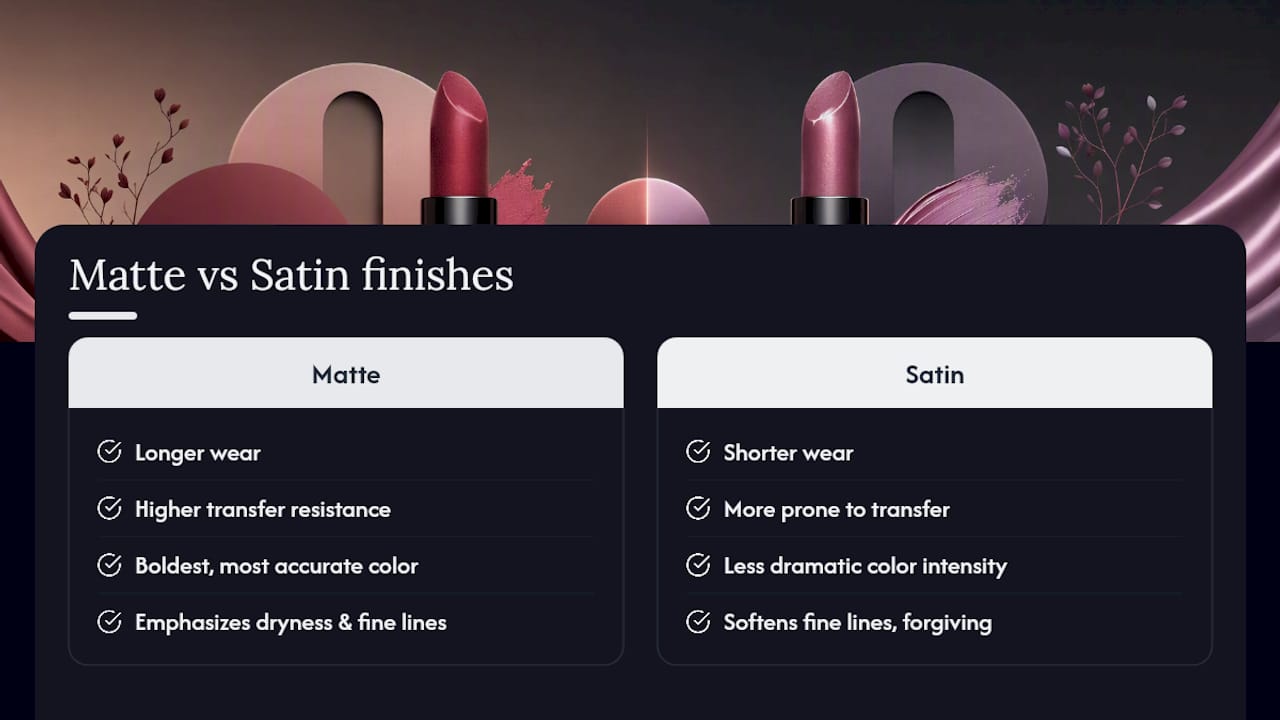
Matte cons: can emphasize dryness and fine lines, less forgiving on compromised or textured lips, requires more prep to avoid cracking.
Satin pros: more comfortable for extended wear, softens the look of fine lines, buildable and forgiving, better suited to dry or sensitive lips.
Satin cons: shorter wear time, more prone to transfer, less dramatic color intensity than matte.
If you had to pick just one factor to decide by, make it your lip condition on that particular day. Dry, chapped, or textured lips do better in satin regardless of the occasion. Well-hydrated lips can handle matte for as long as the event demands.
Lumeracosmetica’s Guidance for Choosing a Daily Finish
Lumeracosmetica’s own application guides echo the same technique breakdown covered above, with extra attention to mature or textured lips. Their satin lipstick benefits for mature lips post explains why the soft-sheen finish tends to be more forgiving as lip texture changes over time, while why choose matte lipstick for mature lips covers how to prep properly if you still want a flat finish. Their general lipstick application steps guide is worth bookmarking before you settle on a daily routine.
The Real Mistake People Make Choosing Between Finishes
Most advice on this topic treats matte and satin like a personality choice, as if you’re supposed to pick one and stay loyal to it. That framing doesn’t hold up against how lips actually behave day to day.
Your lip condition changes with the weather, your hydration, and even your skincare routine that week. A finish that worked beautifully in July can crack and flake in January on the exact same lips. The smarter approach, and the one the ingredient science actually supports, is keeping both finishes on hand and choosing based on that day’s conditions rather than brand loyalty to one texture.
This matters most for mature lips, where fine lines make the light-reflecting quality of satin genuinely useful, not just cosmetic marketing. But even then, an important event that demands hours of wear still calls for matte, prepped properly so dryness doesn’t undercut the color. The people who get the best results aren’t the ones who found their “signature finish.” They’re the ones who stopped treating finish as fixed and started treating it as situational.
— Rebecca
Find Your Next Finish With Lumeracosmetica
Lumeracosmetica designs both ends of this spectrum instead of forcing you into one texture, so you’re not stuck reformulating your whole routine every time your lips or your schedule change. If satin’s soft sheen is what you’re after, especially for softening the look of fine lines without extra product, the Ombre Effect Lip Hi-Lighter delivers that gradient, light-reflecting glow in a single easy application.
It’s built to layer cleanly over a hydrating base, which means it works whether you’re using it as a standalone everyday color or pairing it with a matte formula on days when you want depth with a softer edge. Check the product page for shade options and pick the one that matches your everyday routine.
Sources
- Find Your Finish: What Lipstick Formula Is Right For You? | VUE magazine
- Matte vs Satin Lipstick: Which Finish Is Better for Everyday Wear? | The Healthy Curve


